Tidal and Semi-Submerged Sites: Managing UXO Risk
Most UXO survey projects rely on a few basic assumptions. The ground is accessible, stable enough to work on, and available for long enough periods to carry out a survey safely and efficiently.
For many land-based developments, those assumptions hold true. Conventional survey methods can be deployed with relative ease and provide the information needed to manage UXO risk.
Tidal and semi-submerged sites are different. Ground conditions can change throughout the day as the tide rises and falls, while access may depend on boats, narrow tidal windows or ground conditions that cannot support personnel or equipment. In many cases, surrounding infrastructure such as sheet-pile walls, flood defences or marine structures introduces further technical challenges.
Many of these locations are now being redeveloped for infrastructure, coastal defence and waterside construction projects, making effective UXO risk management an important part of project planning.
These constraints do not remove the need to assess UXO risk. Many coastal, riverside and former dockside locations sit within areas that experienced significant wartime activity. The challenge is not whether UXO risk exists, but how to investigate it safely and effectively when conventional approaches are not suitable.
Over the years, Brimstone has supported projects in a range of these environments by adapting survey methodologies to suit the conditions on site. Here are some examples of how we’ve approached that challenge.
Working with the Tide
One of the most significant constraints on a tidal site is time. Survey work can only be carried out when the ground is accessible, meaning programmes often need to be built around tidal movements.
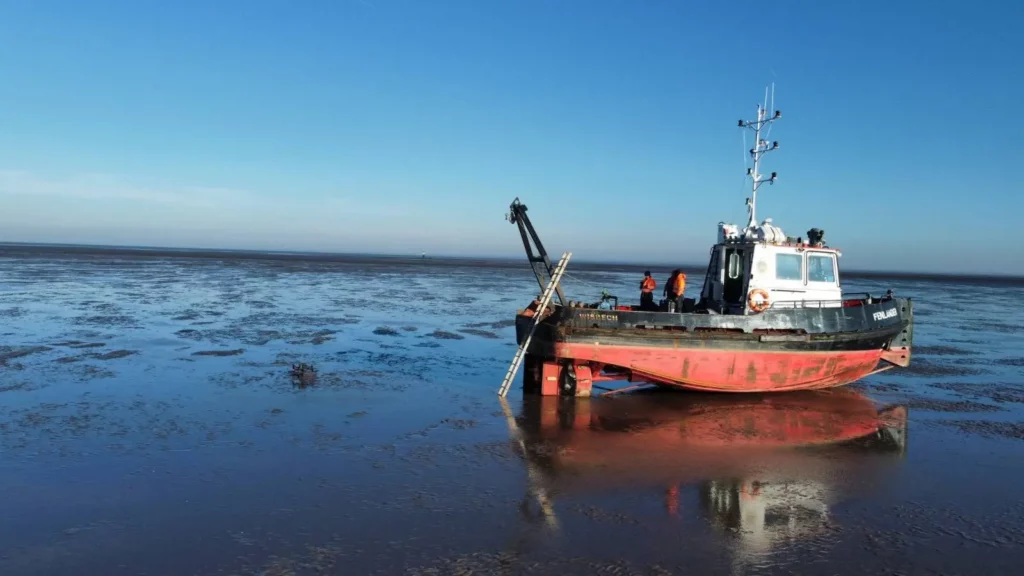
At Wainfleet, Brimstone completed a UAV UXO survey across approximately 100 hectares of tidal mudflats. The soft, waterlogged ground could not support conventional survey equipment, making traditional methods impractical. Access to the survey area was achieved by boat, with survey operations beginning once the tide had receded and sufficient ground had been exposed.
A similar approach was adopted at Holbeach, where boat access was used to reach the survey area before conducting a UAV survey during low-tide conditions.
Drone-based surveys can be particularly effective in these environments, allowing large areas of difficult terrain to be assessed without requiring personnel or heavy equipment to operate directly on unstable ground.
In some situations, the available working windows are limited, making it important to maximise every low-tide period.
At Folkestone Warren, Brimstone supported VolkerStevin on a coastal defence improvement scheme protecting the sea wall and supporting structures that safeguard the railway line between Folkestone and Dover. With work restricted to low-tide periods, the project team operated alternating day and night shifts over several weeks to make use of every available survey window.
Reaching Areas That Cannot Be Accessed Conventionally
Some sites present a different challenge. The survey area may be inaccessible at ground level, unable to support equipment, or located within environments where conventional deployment is not possible.
At Great Yarmouth, Brimstone was engaged following the discovery of a 250kg Second World War bomb in 2023. The project involved surveying areas where standard ground-based methods could not be used.
To overcome these constraints, a probe rig was mounted on an excavator and extended over the water to reach the survey location. This approach also helped maintain separation from nearby sheet-pile walls, reducing the impact of magnetic interference from surrounding steel structures. Elsewhere on the site, a CPT rig was crane-lifted onto the beach to access areas that could not otherwise be reached.
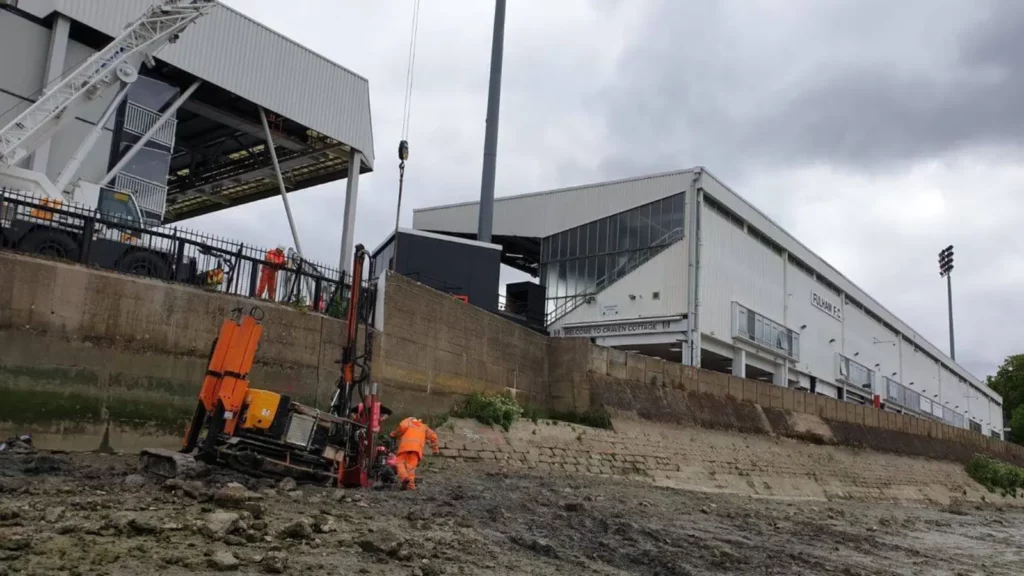
A similar solution was implemented during the Riverside Stand redevelopment at Craven Cottage. Acting as Principal Contractor, Brimstone provided piling clearance support within the tidal River Thames. Survey activities could only take place during low-tide periods, with a specialist mini CPT rig crane-lifted onto the exposed riverbed to investigate the intertidal working area.
These projects demonstrate that access challenges do not necessarily prevent a survey from taking place. They simply require the right combination of equipment, planning and methodology.
When a Simpler Approach Is the Right One
Not every solution involves specialist plant or complex mobilisation.
In some environments, a straightforward manual approach can be the most effective option.
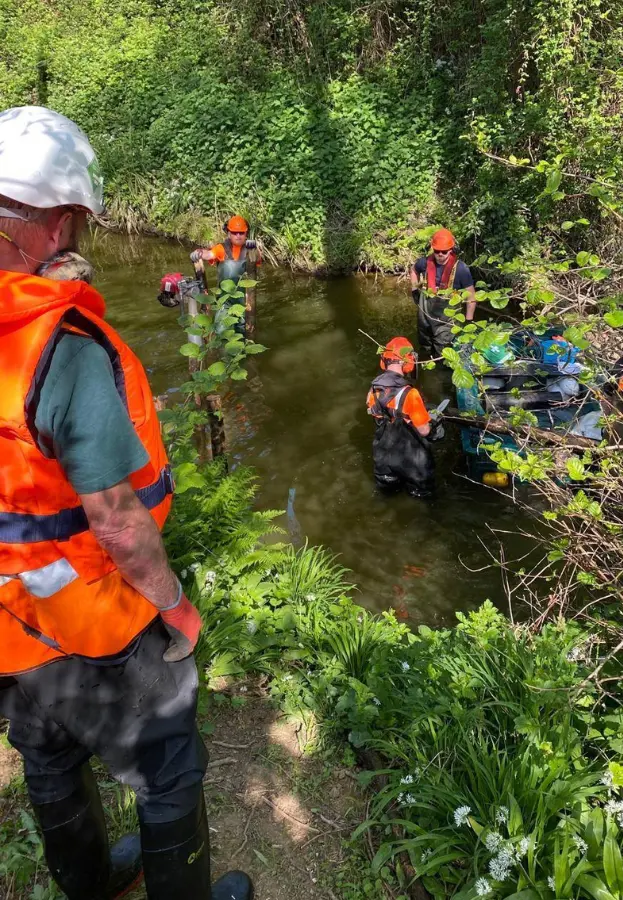
At Tonbridge, Brimstone carried out shallow riverbed clearance ahead of the installation of water deflectors designed to manage flow within a tributary of the River Medway. Working directly within the watercourse, our engineers affixed brass weights to the downhole probe to investigate the riverbed and identify potential UXO-related anomalies.
Although relatively simple, this approach was well suited to the confined, shallow-water environment and allowed the required investigation to be completed safely and effectively.
No Two Sites Are the Same
The common factor across all of these projects is the need to adapt.
A tidal mudflat, an exposed riverbed or a sheet-piled waterfront structure cannot be surveyed in the same way as a conventional development site. Each environment presents its own practical and technical challenges, requiring a methodology designed around the conditions on site.
Assessing UXO risk in these locations is rarely about finding a standard solution. It is about understanding the constraints, selecting the appropriate equipment and developing a programme that works within the available access windows.
When conventional methods are not suitable, the answer is not that the site cannot be surveyed. It’s instead about finding the right way to do it.
If you’re planning works on a tidal, coastal or waterside site and would like to discuss how UXO risk can be assessed in these conditions, our team is happy to help.
For project insights and industry guidance, follow Brimstone UXO on LinkedIn, Facebook, Instagram, and YouTube.
"*" indicates required fields