Why Coastal and Waterway Projects Carry Hidden UXO Risks
Flood defence upgrades, tidal infrastructure schemes, managed realignment projects and shoreline management works are a regular feature of the UK’s development landscape. But one risk factor is consistently underestimated at the planning stage: unexploded ordnance (UXO).
UXO is not just an offshore concern. The UK’s coastline, estuaries, rivers, canals and tidal flats carry a significant and well-evidenced WWII legacy that has direct implications for any scheme involving ground disturbance in these environments.
The assumption problem
Many developers and contractors working on coastal and waterway schemes don’t flag UXO as a primary concern. There is an assumption that these environments don’t carry the same obvious UXO risks as former industrial land, airfields, cities or known bombing targets, but the absence of visible history isn’t the same as the absence of risk.
During WWII, the UK’s coastline and inland waterways were heavily used for amphibious training, coastal battery emplacements, naval mine-laying and defensive infrastructure. Estuaries and river corridors were affected by aerial bombing, wartime industrial activity and the informal disposal of munitions. The legacy of that activity doesn’t disappear because the ground is tidal, or because it’s been underwater.
Why the records don’t tell the full story
UXO risk assessments rely heavily on wartime records including bomb maps, incident sheets, and UXB registers, but these records can be less reliable for coastal and waterway environments compared to urban or rural land.
During the Second World War, a bomb striking open ground would leave a crater. In many cases it would get reported, investigated and recorded. A bomb striking a beach at high tide, a tidal flat or a river, however, would disappear immediately beneath the waterline. No crater, no visible entry point, and often no report. The item may never have been recorded at all.
While working on UXO risk assessments for clients working on coastal defence and waterway schemes across the South East and South West, we’ve identified multiple instances where official bomb density records underrepresent what the wider evidence such as written records, aerial photography, and proximity analysis suggests actually occurred in the area. The records are a starting point, not a complete picture.
Water as a concealment mechanism
The marine and estuarine environment is uniquely effective at concealing UXO. A bomb entering a river, tidal flat or beach during high tide leaves almost no surface evidence. Entry holes in sand or mud infill within hours. In heavily tidal environments, any evidence that was visible at low tide would regularly be erased before it could be observed and reported.
This means that for a significant proportion of coastal and waterway sites, the absence of recorded incidents doesn’t indicate the absence of risk.
We’ve seen this pattern on assessments for groyne repair and coastal defence schemes along the Norfolk and Sussex coasts, and on riverfront site investigations in Bristol and Southampton, where the record appears relatively benign until the environmental factors affecting detection and reporting at the time are properly accounted for.
The migration problem
UXO doesn’t always stay where it landed. In coastal and waterway environments, tidal movement, river currents and coastal erosion all contribute to the migration of ordnance over time. Items can shift in sediment, wash up on shore from adjacent offshore areas, or travel along a coastline from their original point of entry.
This has particular implications for sites with no obvious UXO history of their own. A site may sit adjacent to a former coastal battery, a naval depot or a wartime bombing range without any direct recorded activity within its boundary, and still carry genuine risk as a result of migration from those surrounding areas.
On coastal schemes in Norfolk and Sussex, we’ve found evidence of UXO items washing up from adjacent areas and becoming buried in beach sediment over time, a risk factor that wouldn’t be apparent from a straightforward review of site-specific records alone.
The disposal culture
During and after both World Wars, the informal disposal of surplus, obsolete and damaged munitions into bodies of water was widespread. At the time, it was treated as a straightforward solution, following an out of sight, out of mind mentality. Governments and armed forces adopted the same mentality, operating on the assumption that munitions disposed of in water, and disposed of deep enough, would cease to present any future risk.
That disposal wasn’t limited to the sea. Rivers, lakes, canals and estuaries (bodies of water never intended to be drained or developed) all received munitions through both official dumping operations and informal, unauthorised disposal activities. A waterway provided a convenient and consequence-free means of getting rid of surplus or faulty ordnance, leaving no visible evidence and attracting little scrutiny.
The scale of this problem has been brought into sharper focus in recent years by the rise of magnet fishing, a hobby involving the use of powerful magnets to recover metal objects from bodies of water. While enthusiasts typically retrieve historical artefacts and scrap metal, items of UXO are regularly recovered, offering a visible reminder that what was disposed of in UK waterways during the twentieth century has not gone away.
Allied UXO risks
German bombs are the risk most people associate with UXO on development sites, but on coastal and waterway schemes, Allied UXO frequently presents an equal or greater risk.
The UK’s southern and eastern coastlines were heavily fortified during WWII. Coastal batteries, anti-tank defences, pillboxes and ammunition dumps were established along stretches of beach and estuarine ground that are now the subject of flood defence and infrastructure works. Embarkation points and supply depots on tidal rivers were active with personnel and ordnance in the build-up to operations including the D-Day landings.
Surplus and faulty ordnance from these installations, caches buried for tactical use and never recovered, and ammunition disposed of informally in adjacent waterways all contribute to an Allied UXO risk profile that is often overlooked entirely at the planning stage.
On UXO risk assessments covering coastal defence schemes in Sussex, flood defence works in Devon and waterfront developments in Southampton, we’ve consistently found that Allied UXO risk is a significant factor, and in some cases the primary driver of the recommended mitigation.
Why standard survey approaches don’t always apply
Even where UXO risk is identified early, coastal and waterway environments present unique challenges that require specialist planning.
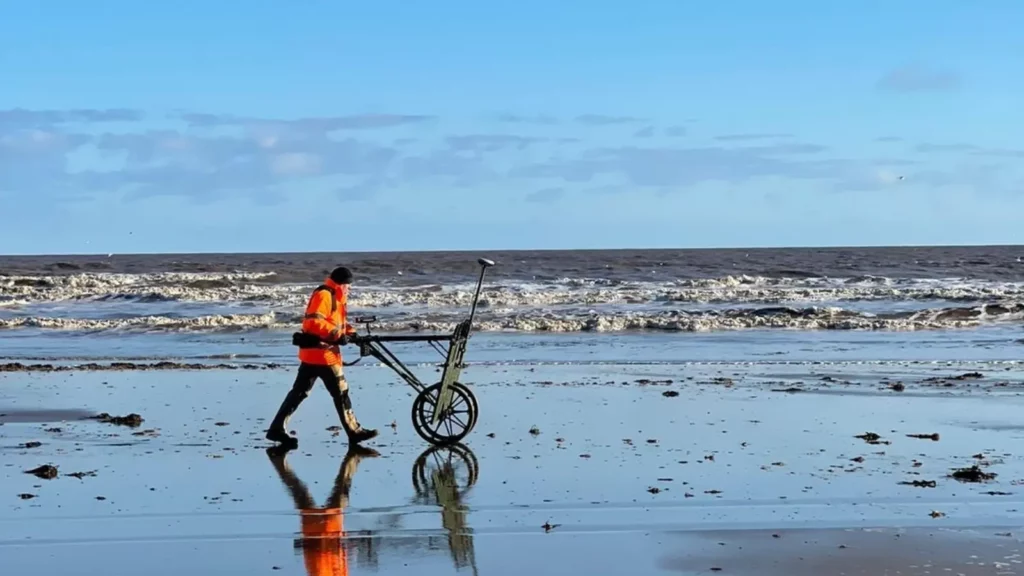
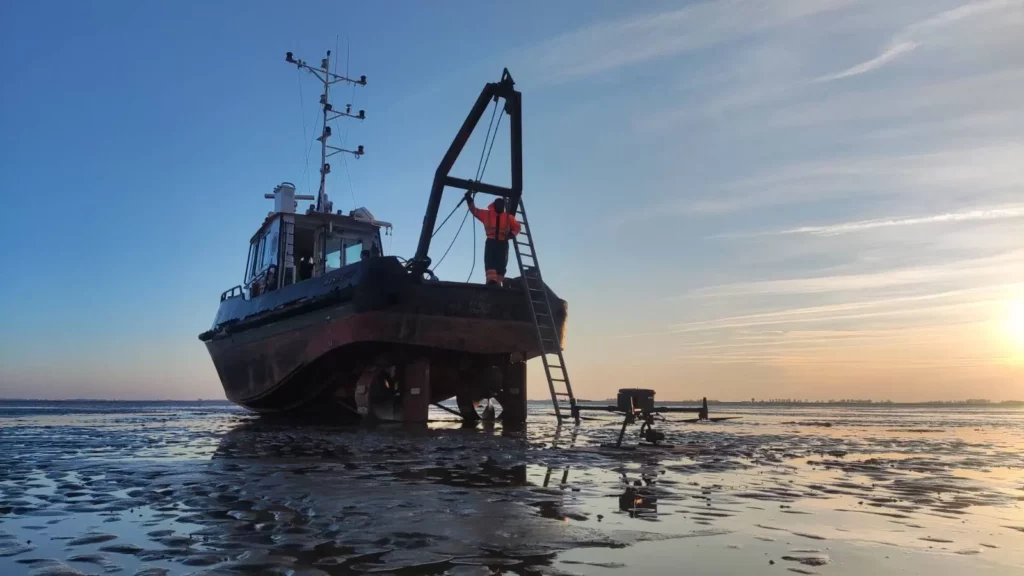
Standard UXO surveys or onsite support may not be straightforwardly applicable to tidal, waterlogged or semi-submerged ground. The risk mitigation methodology has to be adapted to the environment, with tide windows dictating access, ground conditions affect equipment deployment, and in some cases survey work that can only be carried out during specific seasons or states of tide. All of this work is also often required to fit around the wider works programme.
These constraints aren’t insurmountable, but they take time to plan around.
The programme risk
Late engagement with UXO on coastal and waterway schemes creates programme risk that is difficult to recover from. Survey windows on tidal and coastal sites can be narrow, environmental constraints may limit access to specific months, and specialist methodology requires planning time that isn’t available if UXO is first considered after a contractor is already on site.
The constraints are manageable when UXO is built into the programme from the outset. They can be significantly harder to work around when they’re identified late.
What to do next
If you’re working on a flood defence scheme, tidal infrastructure project, managed realignment scheme or any development involving ground disturbance in a coastal or waterway environment, UXO risk assessments should be built into your programme from the outset, before any groundworks begin.
Brimstone provides UXO risk assessments, non-intrusive and intrusive surveys and on-site support for coastal and waterway schemes across the UK. To discuss your project, contact us on 020 7117 2492 or at enquire@brimstoneuxo.com.
For regular updates, project insights, and industry guidance, follow Brimstone UXO on LinkedIn, Facebook, Instagram, and YouTube.
"*" indicates required fields