1 year of Honey Badger
This month marks a significant milestone for our rig fleet as we celebrate the one-year anniversary of Honey Badger joining Brimstone UXO. Over the past 12 months, this specialist rig has played a vital role in UXO risk mitigation across the UK, helping to keep construction and infrastructure projects safe from the hidden dangers of unexploded ordnance (UXO).
In this blog, we’re reflecting on Honey Badger’s journey, its key discoveries, and where it’s headed next.
The story behind Honey Badger
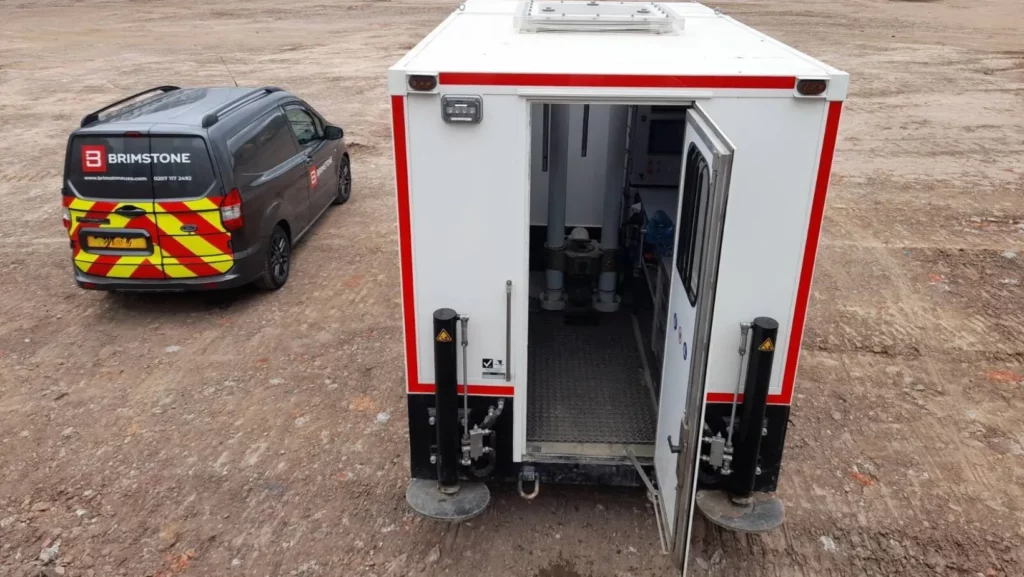
For those unfamiliar with Honey Badger, it is one of our cone penetrometer testing (CPT) rigs, used for intrusive UXO surveys. Built and shipped from the Netherlands, this state-of-the-art rig is an essential tool in our efforts to detect and mitigate UXO risks before large-scale excavations or intrusive works begin.
How does Honey Badger work?
The rig is mounted on a crawler undercarriage and resembles a box-like container. It operates by using hydraulic pressure to push a hardened metal cone into the soil. As it penetrates the ground, reaching depths of up to 20 metres, the rig uses magnetometry, a passive sensing technology, to detect metallic anomalies beneath the surface. This allows us to identify suspicious objects that may be UXO, reducing the risk for construction crews and ensuring safe site development.
Why ‘Honey Badger’?
The rig is named after Captain Phil Nolan, a former Royal Engineer Search Advisor affectionately known as ‘the Honey Badger’. The name reflects both his tenacity in the field and the rig’s unyielding ability to tackle challenging ground conditions.
Key discoveries: Honey Badger’s first year in action
Over the past year, Honey Badger has been deployed at sites across the UK, from Exeter and Swansea to Folkestone, Glasgow, and Liverpool.
Among its most notable discoveries are:
- Two 50kg German air-dropped bombs.
- One 250kg German air-dropped bomb.
These finds underscore the rig’s effectiveness in detecting UXO, highlighting the importance of thorough UXO surveys in safeguarding construction and infrastructure projects. The detection and safe removal of these hazardous items prevent potential accidents and costly delays, allowing projects to move forward with confidence.

Where is Honey Badger heading next?
As we move into the summer months, Honey Badger has a packed schedule ahead.
Currently, the rig is deployed on an ongoing project in Deal, in the Southeast of England, where it continues to support UXO risk mitigation efforts. Once its work in Deal is complete, Honey Badger will head to new sites in:
- Bristol – aiding in the safe development of a brownfield site earmarked for new housing.
- Central London – assisting with pre-construction UXO surveys in preparation for major infrastructure works.
The role of Intrusive UXO Surveys in construction safety
At Brimstone UXO, intrusive UXO surveys are a cornerstone of our comprehensive risk mitigation services. By combining Honey Badger’s capabilities with other advanced technologies, we help clients manage UXO risks effectively.
Alongside CPT surveys, we offer:
- Non-intrusive UXO surveys – using surface-level techniques to detect anomalies.
- UXO risk assessments – evaluating the likelihood of encountering UXO on a given site.
- Investigation and disposal services – safely identifying and removing ordnance where required.
Our team’s expertise ensures that construction, infrastructure, and development projects can proceed without unnecessary UXO-related disruptions.
Partner with Brimstone UXO for safe, efficient UXO risk mitigation
If you’re starting a new project and require UXO support, get in touch with our dedicated commercial team. With extensive experience in UXO detection, investigation, and clearance, we provide tailored solutions to meet the specific needs of your site.
Contact us today to discuss your project requirements and ensure your site is safe, compliant, and ready for development.
Follow us on Facebook, Instagram, Twitter, LinkedIn and YouTube to keep up with our latest projects, industry insights, and safety tips.
"*" indicates required fields