Working to the Tide: How Timing Shapes Coastal UXO Surveys
On most development sites, UXO surveys can be scheduled with a degree of flexibility. The ground is accessible, it generally remains accessible, and survey teams can work a normal day within the wider construction programme. Coastal and estuarine sites present a different set of challenges. The ground may only be accessible at certain stages of the tide, access can depend on boats or specialist equipment, and the periods in which survey work can be carried out may be measured in hours rather than days.
This means UXO surveys cannot always be treated as a task that can simply be scheduled once a contractor is mobilised. On coastal and estuarine projects, the survey programme needs to be considered alongside tidal windows, environmental restrictions, access requirements and the wider construction sequence. Where these factors are understood early, the survey can be planned around the available opportunities and delivered without creating unnecessary disruption to the main works.
The working window is short and fixed
On a conventional land-based site, there is often some flexibility if a survey takes longer than expected or needs to be added in last minute. Working hours may be extended, additional resources can potentially be brought in, or activities can be rearranged to recover time. On a tidal site, however, the available working window is determined by the tide and cannot be changed to suit the programme.
A low-tide window may only last for a few hours, and its timing shifts by roughly 20 minutes each day. Depending on the location and time of year, some windows may also fall during darkness, meaning that the amount of time available for survey work can vary considerably from one day to the next. Two low tides will occur within a 24-hour period, but only one may fall at a practical time for the survey, while on other days both may be suitable for working.
The result is that the amount of productive survey time available can be considerably less than it would be on an inland site, and the programme needs to be structured around the specific tidal windows rather than a standard working calendar. Planning a coastal UXO survey therefore requires consideration of the tide table well in advance, with the survey methodology, resources and working patterns aligned to the periods when the site can be accessed.
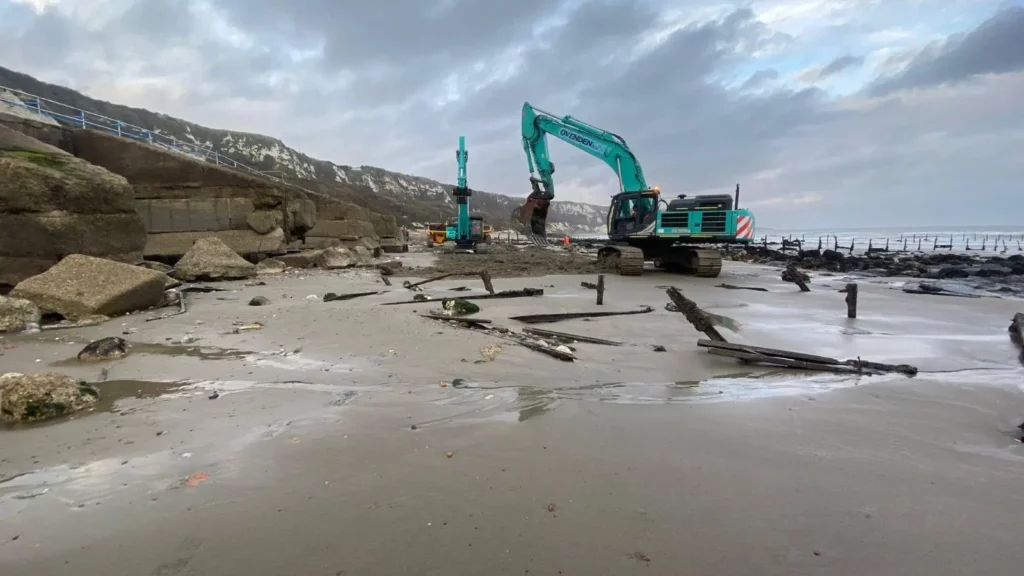
This can also influence how the survey is delivered. On a coastal defence scheme at Folkestone Warren, where we supported works protecting the sea wall and railway line between Folkestone and Dover, alternating day and night shifts were used over several weeks to make use of the available low-tide windows. A conventional day-shift programme would have significantly reduced the amount of time available for survey work, particularly where low tides fell outside normal working hours.
Arrangements such as these need to be considered as part of the programme from the outset. Crews, welfare facilities, lighting and other supporting requirements all need to be planned around the tidal working pattern, rather than being arranged once the survey team is already on site.
The tide is rarely the only constraint
Although the tide is often the most obvious consideration, it is rarely the only factor affecting when UXO survey work can take place. Many coastal and estuarine sites are located within or alongside environmentally sensitive areas, where seasonal restrictions can affect access, noise, disturbance and the timing of construction activities.
Bird nesting and overwintering periods, marine mammal considerations and fisheries constraints can all influence when work can be carried out. These restrictions may remove weeks from the available programme and do not necessarily align with either the tidal cycle or the wider construction sequence.
This creates a scheduling challenge in which several different constraints need to be considered together. The tide determines the hours in which the survey team may be able to work, seasonal and environmental restrictions can determine which parts of the year are available, and the wider construction programme determines when the UXO survey needs to be completed.
Managing these constraints is therefore not simply a question of increasing resources or working more quickly. The number of genuinely available survey windows may be limited, and missing those windows can have consequences for the wider programme.
This is why early planning is particularly important on coastal and estuarine projects. Understanding when the work can realistically be carried out allows the UXO survey to be coordinated with other project requirements before key programme dates are fixed.
Access is not always straightforward
The practical challenge of reaching the survey area also needs to be considered at an early stage. Soft or waterlogged ground may not support conventional survey equipment, while intertidal areas and sections of open water may not be accessible on foot at all. Depending on the site, specialist access arrangements may therefore be required.
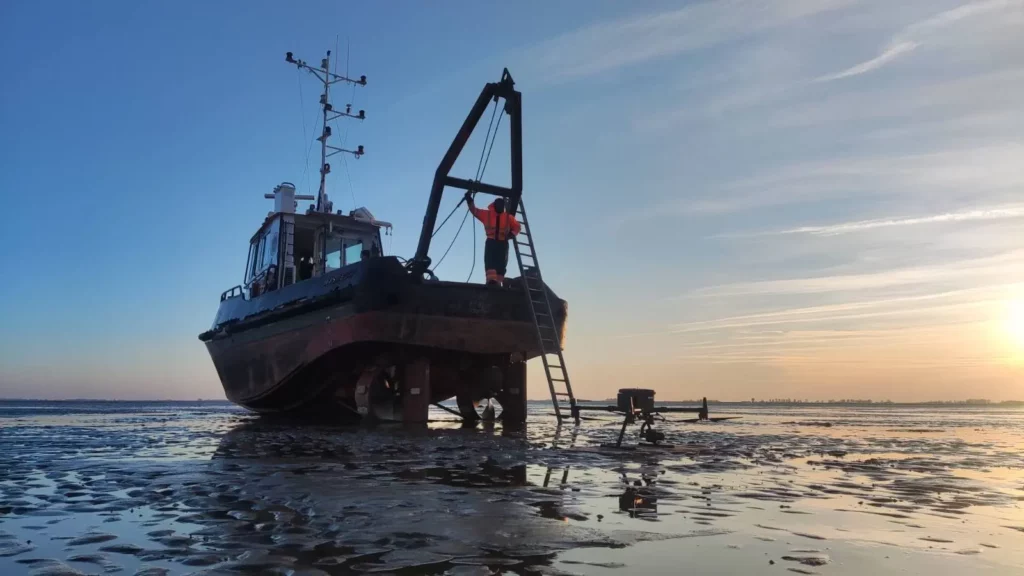
Across our coastal survey work, this has included using boats to access tidal mudflats for UAV surveys at sites such as Wainfleet and Holbeach. At Great Yarmouth, an excavator-mounted probe rig was used to reach out over the water, alongside a CPT rig that was crane-lifted onto the beach.
These types of arrangements often require more planning than a standard land-based survey. Specialist plant, boats and lifting operations may each have their own lead times, permits and logistical requirements, while weather conditions can affect when they can be mobilised and used.
All of these factors need to be coordinated within the same limited working windows as the survey itself. The method of accessing the site is therefore not simply a logistical detail to be resolved at mobilisation. It forms part of the survey programme and needs to be considered alongside the tidal and environmental constraints from the beginning.
Why early UXO engagement matters
When these factors are considered together, it becomes clear why early UXO engagement is so important on coastal schemes. Tidal windows are fixed, environmental restrictions can limit the available working season, specialist access may require significant preparation, and the survey still needs to be completed in time to support the wider construction programme.
Each of these constraints can be managed effectively when UXO requirements are considered during the early stages of project planning. However, the options available become considerably more limited when UXO is first addressed after a contractor has been mobilised and programme dates have already been committed.
The potential impact of late engagement is therefore not limited to the UXO risk itself. On a coastal or estuarine site, it may not be possible to recover lost time simply by increasing the survey resource or extending the working day. If the available tidal window has passed, the team may have to wait for the next suitable opportunity. If seasonal restrictions apply, the delay could be considerably longer.
This is particularly important where intrusive groundworks or construction activities are dependent on the completion of the UXO survey. A delay to the survey can then affect subsequent activities, with the potential to create knock-on impacts across the wider programme.
Early engagement allows these constraints to be understood before they become programme issues. It provides an opportunity to identify the appropriate survey methodology, assess access requirements, consider potential working patterns and establish how the UXO works can be coordinated with the wider construction sequence.
Planning for coastal UXO surveys
If you are planning a flood defence scheme, tidal infrastructure project, managed realignment scheme or any other works involving ground disturbance in a coastal or estuarine environment, UXO should be considered during the programme design stage.
Early consideration allows tidal windows, environmental restrictions, access arrangements and survey requirements to be assessed before the construction programme is fully committed. It also provides greater opportunity to identify potential constraints and develop a proportionate approach to managing the risk.
Brimstone provides UXO risk assessments, non-intrusive and intrusive surveys, and on-site support for coastal and estuarine schemes across the UK. Our team has experience delivering UXO services in some of the most access-constrained environments, including sites where tidal conditions, environmental restrictions and specialist access requirements all need to be considered as part of the survey planning process.
If you are planning works in a coastal or estuarine environment and would like to discuss the potential UXO requirements for your project, contact us on 020 7117 2492 or at enquire@brimstoneuxo.com.
For regular updates, project insights and industry guidance, follow Brimstone UXO on LinkedIn, Facebook, Instagram, and YouTube.
"*" indicates required fields