Submerged UXO: The Threat of the SS Montgomery
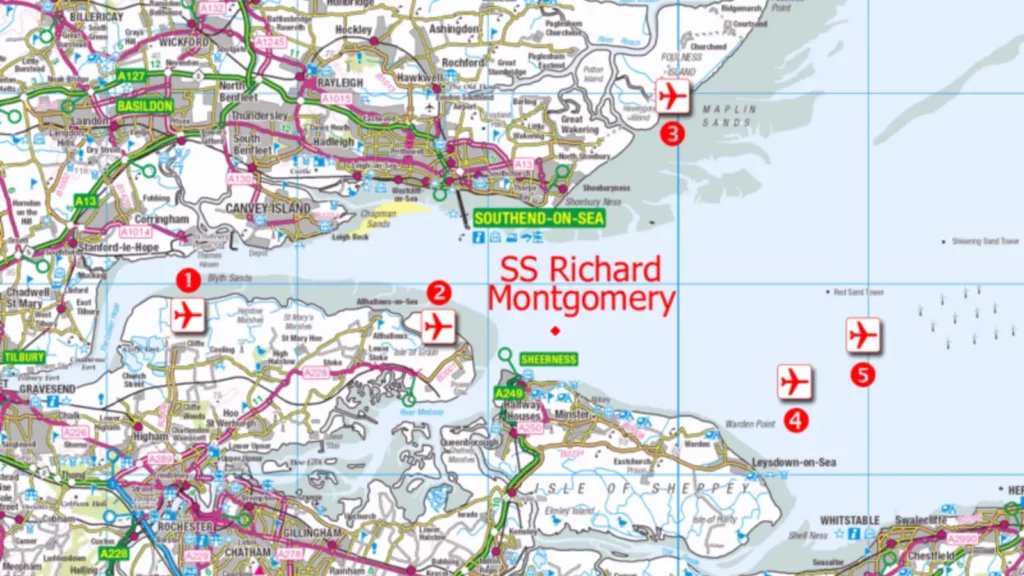
For nearly eight decades, the wreck of the SS Montgomery has rested beneath the waters off the coast of Sheerness, Kent. This sunken Second World War cargo ship is no ordinary wreck – it contains an estimated 1,400 tonnes of explosive material, making it one of the most hazardous submerged munitions sites in the world.
Despite the wreck’s relative stability over the years, the potential for a catastrophic detonation remains a serious concern. Fortunately, the UK government is now taking action to reduce the risks posed by this time bomb beneath the waves.
The SS Montgomery: a tragic final voyage
The SS Richard Montgomery was one of the American Liberty Ships – a fleet of mass-produced cargo vessels used to transport ordnance and war supplies from the US to Allied forces in Europe during the Second World War.
In August 1944, while carrying 6,225 tonnes of bombs and ammunition, the vessel ran aground on a sandbank near Sheerness. Despite efforts to salvage its dangerous cargo, the operation was halted when the Admiralty refused to pay the workers additional danger money for unloading live munitions.
The wreck eventually split apart and sank to the seabed, leaving behind a deadly legacy. Though some of the munitions were recovered, approximately 1,400 tonnes of explosives remain trapped in the corroding hull.
The ongoing threat: a time bomb beneath the waves
For decades, the wreck has sat 15 metres below the surface, with its rusting masts still visible above the waterline. In the 1960s, locals were known to fish atop the wreck, unaware of the potential danger lurking below. Incredibly, fishing boats even deposited unexploded war bombs onto the ship’s deck – a shocking reflection of the lack of awareness surrounding the risks at the time.
Today, the SS Montgomery is encircled by a 100-metre-wide exclusion zone, marked by warning buoys. The area is under constant radar and visual surveillance to prevent unauthorised vessels from approaching. Despite these precautions, the wreck’s location poses an ongoing threat due to the intense marine traffic in the area.
Thousands of ships pass within just 200 metres of the wreck each year, using one of the UK’s busiest shipping lanes. This proximity increases the risk of accidental disturbance. Nearby, the Isle of Grain, less than five kilometres away, hosts an oil-fired electricity generating station and large tanks of liquefied natural gas (LNG). Supertankers carrying LNG regularly pass close to the wreck, adding to the potential consequences of a detonation.
The threat also extends to the land. The wreck is located just 2.4 kilometres from Sheerness on the Isle of Sheppey. Experts warn that if the remaining explosives were to detonate, the blast could propel metal and munitions over three kilometres into the air, with widespread destruction on both land and sea.
Government action: reducing the risk
In recent years, the SS Montgomery has undergone routine surveys and thorough risk assessments. With the wreck gradually deteriorating, the UK government has committed to action, determined to prevent an accidental detonation event before the ship’s condition worsens.
The current plan focuses on cutting back the ship’s iconic steel masts, which rise above the waterline. The masts are at risk of collapsing onto the hull, which could potentially trigger a blast. By reducing the weight of the masts and removing the risk of them falling, the government aims to lessen the chance of an unintended explosion.
However, questions remain about the long-term fate of the wreck. While removing the masts addresses some of the structural risks, the explosives themselves remain. The complex task of extracting or safely disposing of the munitions will require extreme caution. Similar operations have proved perilous in the past, such as the 2020 detonation of a Polish WWII bomb in the Piast Canal, which exploded unexpectedly during a controlled disposal attempt.
Submerged UXO: the wider risks
The SS Montgomery is a high-profile example of the dangers posed by submerged unexploded ordnance, but it is far from the only one. Around the UK and across Europe, countless UXO-contaminated wrecks lie beneath the seabed, creating hazards for shipping routes, offshore energy projects, and marine environments.
UXO from past conflicts continues to threaten modern infrastructure. Offshore wind farms, subsea cables, and oil and gas operations frequently encounter UXO, requiring detailed risk assessments, surveys, and clearance operations to ensure safety.
Brimstone UXO: supporting safe offshore projects
At Brimstone UXO, we are specialists in UXO risk management, offering a range of UXO services. Our expert team provides:
- UXO Risk Assessments: Identifying potential hazards at sea and on land, evaluating the likelihood and impact of encountering UXO.
- UXO Surveys and Detection: Using advanced equipment, including marine magnetometry and multibeam sonar, to detect and map submerged UXO.
- UXO Investigation and Clearance: Safely identifying, investigating, and disposing of unexploded ordnance using proven methodologies.
Our experience in both terrestrial and marine UXO risk management ensures that clients can progress with confidence, knowing their projects meet strict safety standards.
For the latest news and insights on UXO risk management, follow Brimstone UXO on: Facebook, Instagram, Twitter, LinkedIn and YouTube.
"*" indicates required fields