How Remnant Uses OSINT to Map UXO Risk
A bomb is found during groundworks in one town. A wartime shell washes up on a beach a county away. A cordon goes up around a building site while a disposal team makes a device safe, and a few lines appear in the local paper the next morning. Each of these is reported somewhere. None of them are reported in the same place, in the same format, or to the same audience.
That’s the reality of UXO information in the UK. It’s fragmented, with reports spread across local and regional news, clearance and cordon notices, and sector updates. Anyone trying to understand the wider picture has to go and assemble it themselves, source by source, knowing they’re probably missing as much as they find.
Pulling scattered public information into a usable picture is precisely what open-source intelligence (OSINT) does, and it’s the foundation on which Remnant is built.
What counts as open source
OSINT is intelligence produced by collecting, evaluating and analysing publicly available information to answer a specific intelligence question. It is not simply gathering whatever is public, but doing so with a defined question in mind and applying judgement to what is collected. For Remnant, the question is: what does the reported picture tell us about UXO contamination across the UK?
Publicly available means information that is open by nature, not classified, leaked or privileged. For Remnant, this means looking at local and regional news reporting, official clearance and cordon notices, and a range of other publicly reported signals that indicate ordnance has been found, suspected or dealt with.
None of this information is sensitive. Remnant draws exclusively on open, publicly available sources and does not hold classified material.
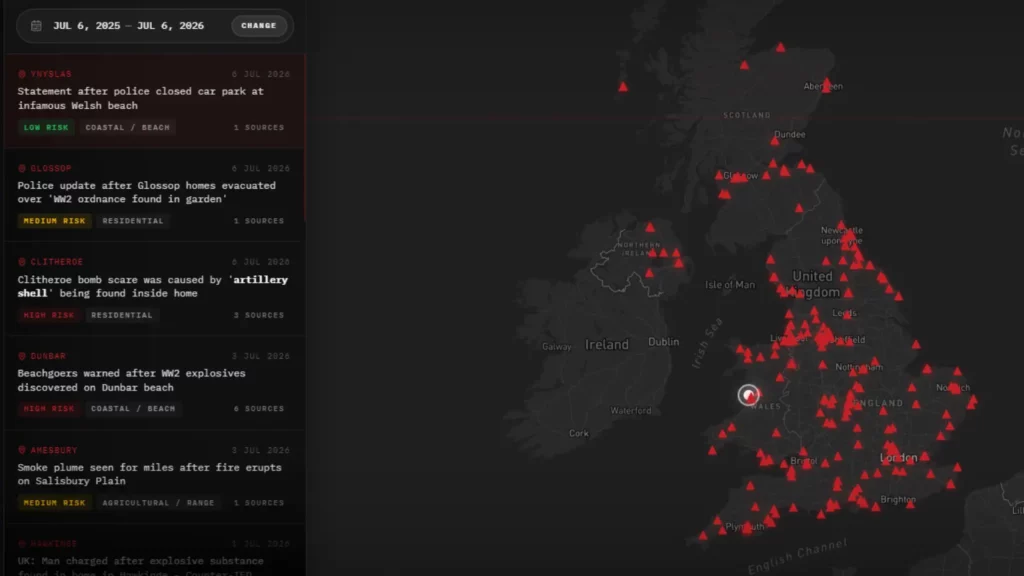
Remnant collects, evaluates and analyses scattered public reports, turning them into one coherent picture.
From single reports to a real picture
A single report tells you that one thing happened in one place. It’s useful to the people directly involved, but it tells you little about the wider pattern. Intelligence emerges only when many reports are brought together and their shape becomes visible. For Remnant, that means seeing where UXO finds cluster, which ordnance types recur in particular areas, and how patterns change over time.
Building that picture can be difficult because the underlying reporting is inconsistent. The same incident can be covered by several outlets, described in different terms and with different levels of accuracy, sometimes days apart. A clearance operation might be reported once and never followed up. Locations are often approximate. Some reports are duplicates of the same event; others look similar but are not.
Turning this scattered information into something dependable takes more than collecting links. It takes a process.
From raw signals to usable intelligence
In a UXO context, that process runs in stages.
The first is ingestion. Remnant continuously monitors a broad range of open-source feeds, identifying reports that relate to UXO and ERW as they are indexed, rather than days or weeks later. Speed is part of the value, because an incident feed is only useful if it reflects what is happening now.
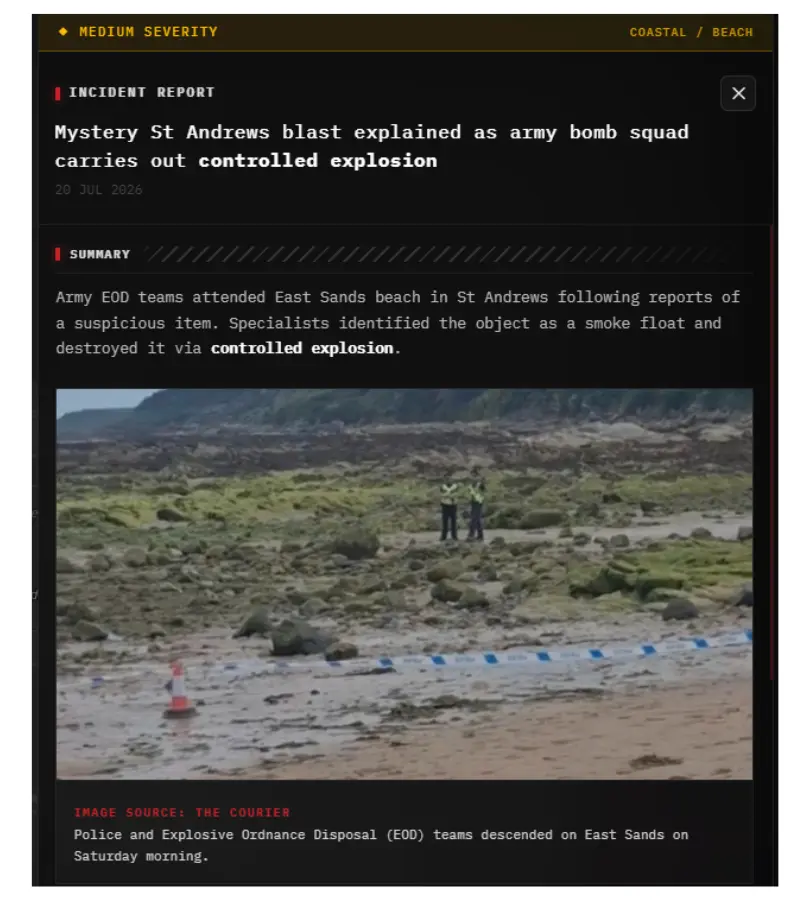
The second is structuring. A raw report is not intelligence until it has been made consistent. Each incident is located geographically, classified, and organised so it can be searched, filtered and compared against the wider dataset. This is what turns a stream of individual reports into structured data.
The third is deduplication and review. As a single event can surface across multiple sources, the data is cleaned so that each incident is counted once. This is also where human judgement comes into play. Automated monitoring is effective at finding and flagging reports, but it is less reliable when making finer distinctions, such as whether two reports describe the same event or whether a report is relevant at all. Analyst review is what keeps the dataset accurate.
At the higher Remnant subscription tiers, that same analytical discipline extends further with geographic clustering, trend analysis, ordnance-type breakdowns and pattern recognition, alongside reports validated by Brimstone’s trained analysts and delivered in line with the principles of IMAS 05.10.
What OSINT can and can’t tell you
Being clear about what OSINT cannot do is part of what makes it trustworthy.
OSINT reflects what has been publicly reported. If an incident is never reported in indexed media, it won’t appear, no matter how thorough the monitoring. That means Remnant is a powerful way to understand the reported picture, but it is not a complete record of every piece of ordnance in the ground.
This is why Remnant is an intelligence tool, not a substitute for site-specific work. It’s built to be used alongside UXO risk assessments and professional EOD advice, helping users ask better questions and make more informed decisions earlier, rather than replacing the work required to establish and manage the actual risk on a particular site.
Used in that way, OSINT does something genuinely valuable: it takes a risk that has always been known but rarely visible and makes it possible to see.
See the picture for yourself
Remnant is live now, covering the UK. The free tier gives you access to the live incident feed and map with no commitment and no card required, so you can see how the data comes together before deciding whether a paid tier fits the way you work.
For regular UXO intelligence, data insights and platform updates, follow Remnant on Instagram, LinkedIn and X.
"*" indicates required fields