Plymouth_
CASE STUDY
Brimstone collaborated with Plymouth City Council, Devon and Cornwall Police, and military partners on a sensitive Target Investigation in Millbay, Plymouth, highlighting the importance of cross-agency cooperation in UXO risk mitigation.
Brimstone UXO collaborated with Plymouth City Council, Devon and Cornwall Police, and military partners on a sensitive operation in Millbay, Plymouth.
The project involved the careful excavation of two anomalies detected beneath a car park, which were suspected of being unexploded ordnance (UXO). With the safety of the local community as the top priority, the operation successfully confirmed that the items were not UXO, allowing the area to be safely cleared for a £33.5 million housing development.
This project highlighted the importance of cross-agency cooperation, methodical investigation, and Brimstone UXO’s expertise in UXO risk mitigation.
A precautionary approach
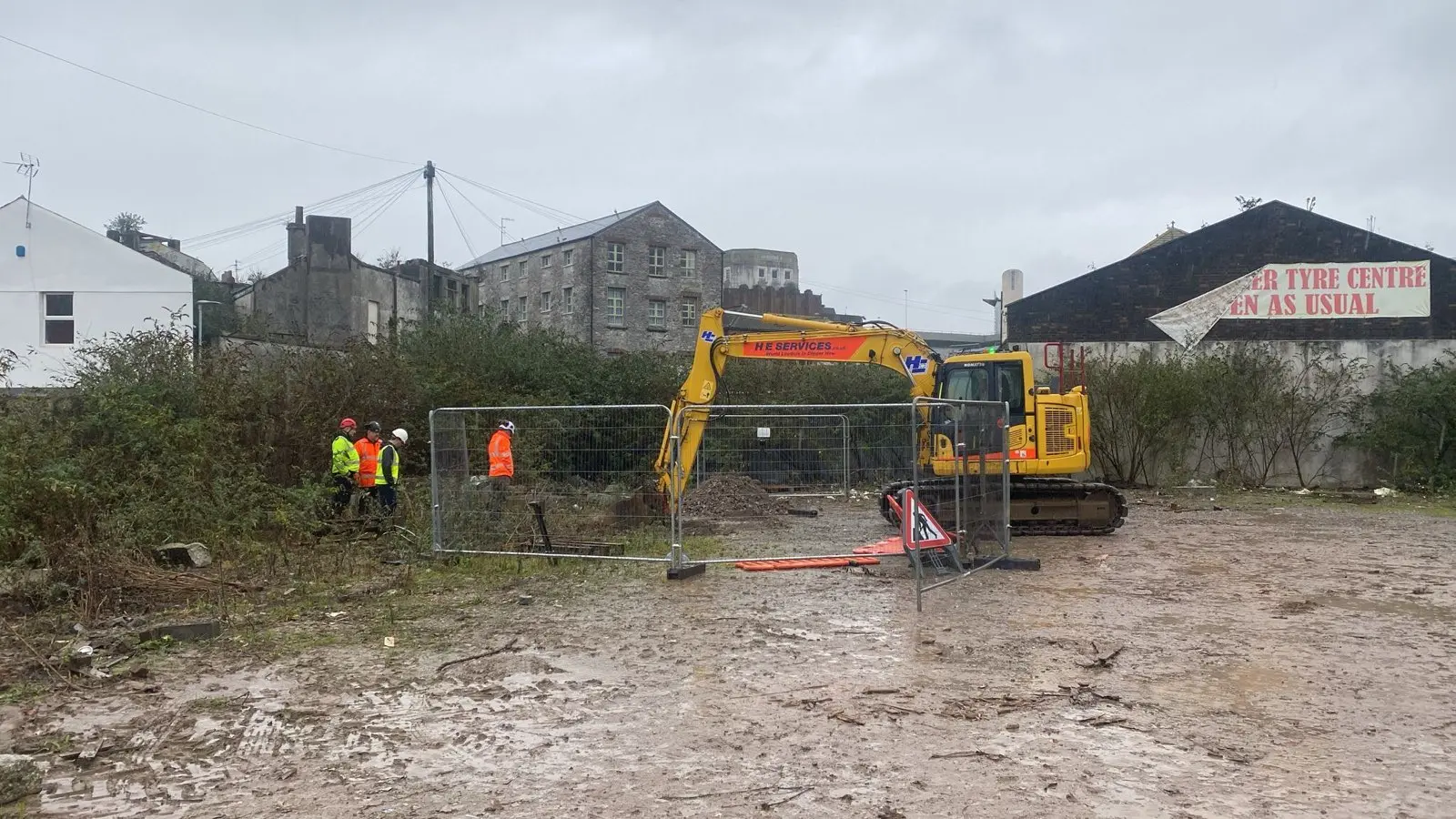
The site in Millbay, earmarked for the construction of 136 homes, had been surveyed by another company around a year prior. During that survey, two buried objects produced signals consistent with potential UXO, prompting the need for a thorough investigation. Given the area’s history and the possibility of wartime contamination, Plymouth City Council took a cautious approach, preparing for all eventualities.
Nearby residents and businesses were advised to be ready for a possible evacuation, and the council warned that a cordon might be necessary should the items prove hazardous. The Royal Navy was placed on standby in case their explosive ordnance disposal (EOD) team was required.
Conducting a target investigation
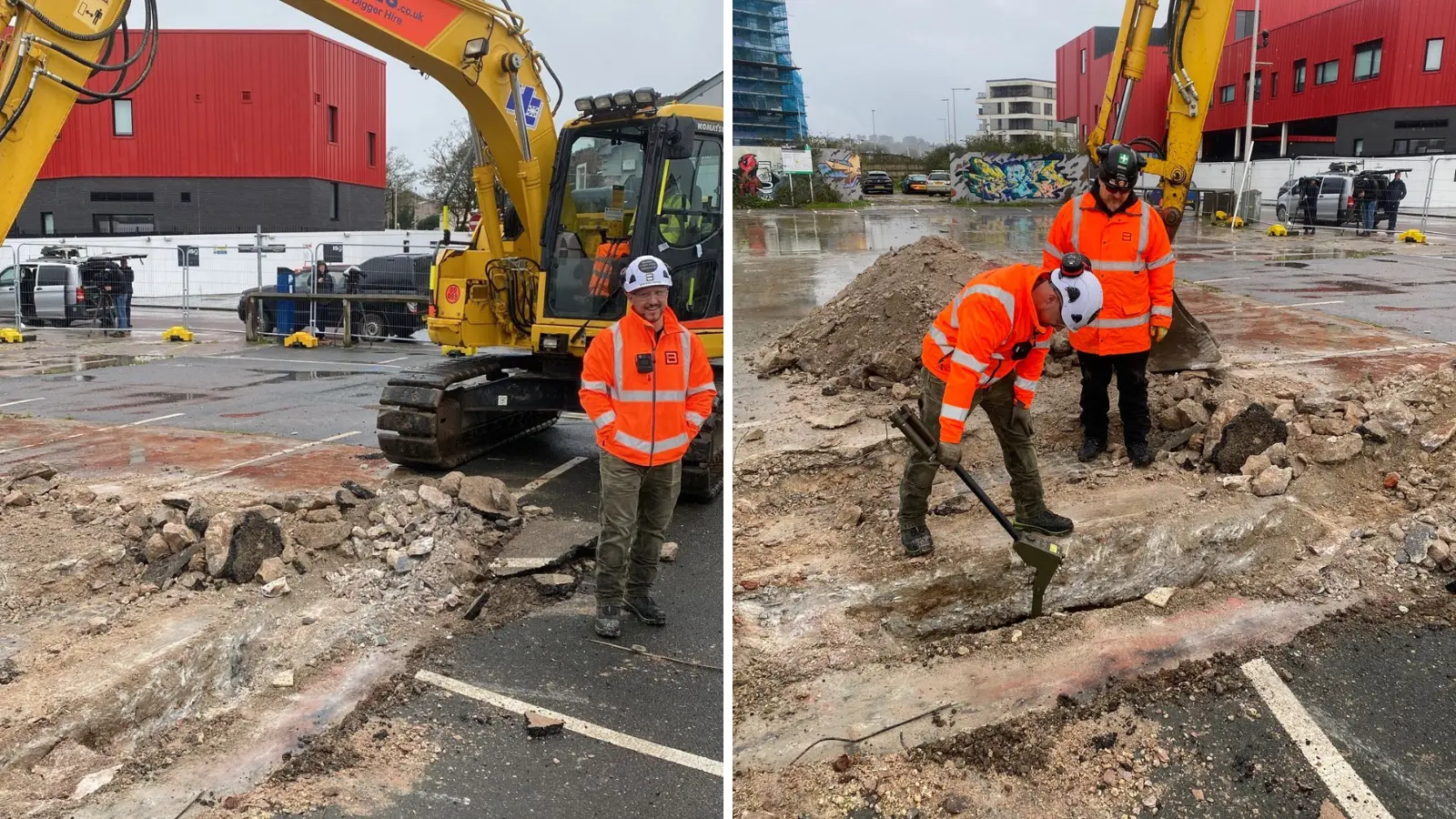
Brimstone UXO, alongside Devon and Cornwall Police, deployed to the site on the morning of the excavation. The team adopted a slow and methodical approach, prioritising safety at every stage.
Site 1: Martin Street Car Park
- The team began excavating the first anomaly, using a 13 tonne excavator with a toothless bucket to carefully scrape away layers of soil.
- Beneath the surface, they uncovered an unexpected concrete slab, which was not identified in the original plans.
- Within this slab was a large quantity of rebar (reinforced steel rod), which had triggered the initial signal.
- After confirming there was no UXO present, the area was deemed safe.
Site 2: Bath Street
- The team then moved to the second anomaly, excavating to a depth of around 1.2 metres.
- This site contained a flat steel plate (approximately 8×6 inches) and part of a cast iron manhole cover, both of which were generating a strong metallic signal.
- Following a thorough inspection, no UXO was identified, and the site was declared safe.
Both excavated areas were backfilled and an ALARP (as low as reasonably practicable) certificate was issued, clearing the way for the planned eco-friendly housing development which will include only 26 parking spaces to promote sustainability.
Collaboration in action
This project exemplified effective cross-agency collaboration, with each partner contributing vital expertise:
- Brimstone UXO led the technical excavation and anomaly investigation, ensuring the operation was carried out with precision and care.
- Devon and Cornwall Police provided on-site security and assisted with public safety measures.
- Plymouth City Council maintained communication with the public, coordinated contingency plans, and prepared for potential evacuations.
- The Royal Navy remained on standby, ready to provide EOD support if the objects had proven to be UXO.
The seamless cooperation between these agencies ensured the target investigation was conducted efficiently and safely, with minimal disruption to the local community.
Press and public interest
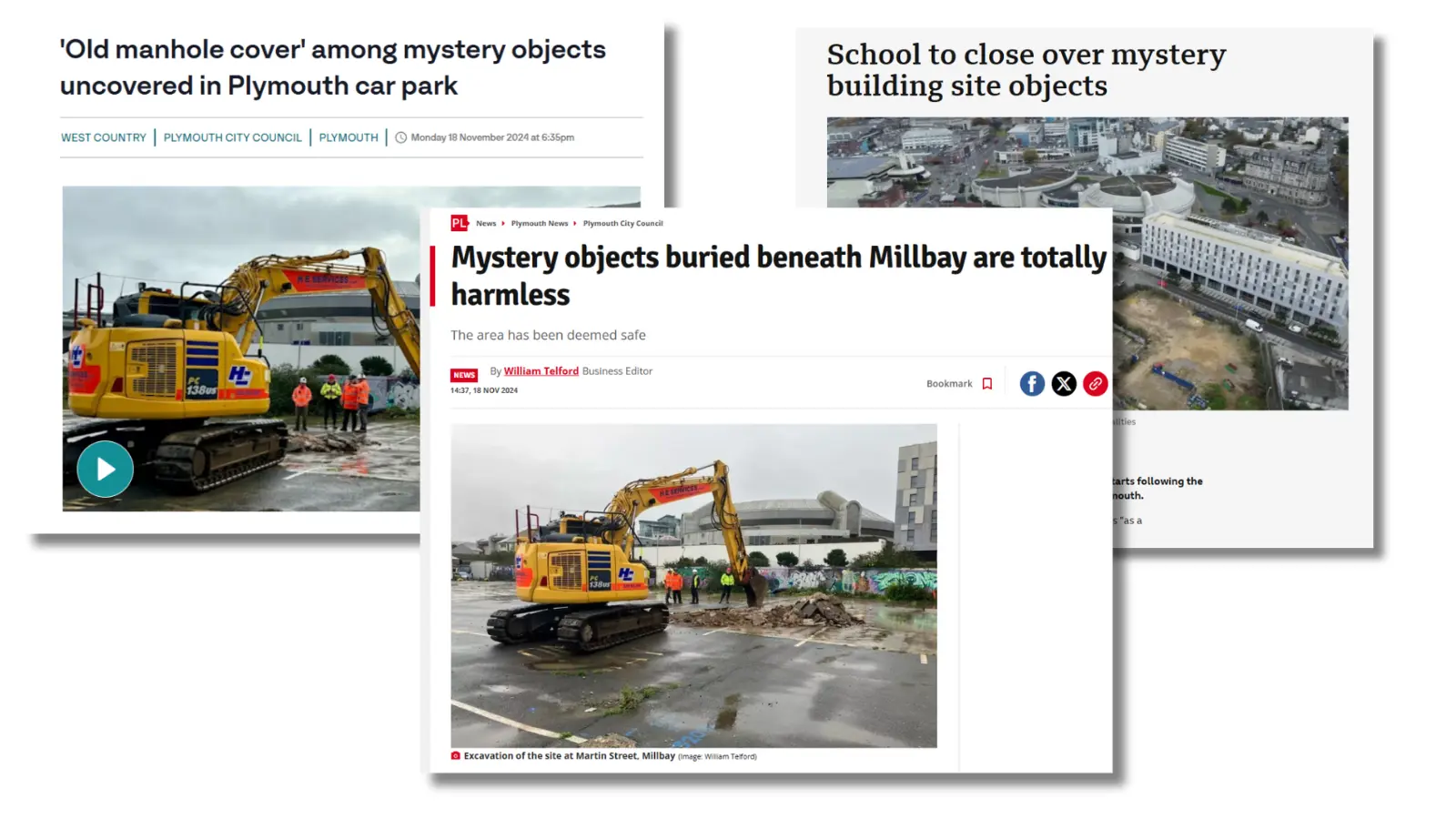
The operation attracted significant media attention, due in part to heightened public concern following a major incident earlier in the year. In February 2024, a 500kg (1,102lb) German World War Two bomb was discovered in a garden on St Michael Avenue in Plymouth. The device triggered the evacuation of more than 10,000 people from 4,300 properties over four days, making it one of the largest evacuations in the UK since the end of World War Two. After being transported through the city in a military convoy, the bomb was eventually detonated at sea.
Given the scale of this recent incident, the public and media were understandably alert to any reports of possible UXO in Plymouth. With live updates from ITV and Plymouth Live, Brimstone UXO’s team demonstrated professionalism in managing on-site media interest, providing clear and accurate information to prevent speculation and maintain public confidence.
Outcome and impact
The successful completion of this project had several important outcomes. First and foremost, the careful investigation and verification of the anomalies eliminated any potential UXO risk, ensuring the safety of nearby residents and workers. With the area confirmed safe, the £33.5 million housing development could proceed without delay. The project also demonstrated Brimstone UXO’s thorough and methodical approach, reinforcing its reputation for professionalism and technical expertise in UXO risk mitigation.
Finally, this project underscores the importance of cross-agency cooperation and meticulous UXO investigation in urban development projects.
If you’re planning a development project or require expert support with UXO risk mitigation, Brimstone UXO is here to help. Our team provides comprehensive UXO risk assessments, surveys, on-site support and UXO disposal and removal, ensuring your project proceeds safely and efficiently.
Need help with UXO but not sure where to start?_
Answer a few quick questions and we’ll point you in the right direction.