The UXO Risks of Former Military Land Being Repurposed for Housing
Across the UK, pressure is mounting to deliver new housing at scale and fast. With the government’s target of 1.5 million new homes over the next five years, developers are increasingly looking beyond traditional plots to meet demand.
Former military land, with its large footprints and existing infrastructure, can seem like a logical solution, but while these locations offer potential for regeneration, they also come with a unique set of risks. High among them: unexploded ordnance (UXO).
At Brimstone UXO, we’ve worked on numerous former military sites now earmarked for housing. The challenges are real, but they can be easily managed with the right approach.
A Legacy Beneath the Surface
Many military sites across the UK have long and complex histories. From airfields and barracks to weapons testing grounds and training ranges, these sites were designed with defence, not development, in mind. During periods of intense activity, particularly around the World Wars and the Cold War, live ordnance was regularly stored, moved, fired or buried on these sites.
While much of this equipment would have been cleared when the military vacated, the clearance standards of the time were often lower than what we expect today. Some areas may not have been cleared at all, especially if future redevelopment wasn’t anticipated.
It’s not uncommon for ordnance to remain undetected underground for decades, and in the context of housing developments, where piling, deep foundations and services trenching are routine, there’s a real risk of disturbing it.
Land Requisitioning in WWII
What developers may not realise is that some of the land now being repurposed for housing was originally taken over by the government during WWII under emergency powers. Through legislation such as the Defence (General) Regulations 1939 and the Emergency Powers (Defence) Act 1939, vast areas were requisitioned to support the war effort – often at very short notice!
Between 1939 and 1946, the War Office alone requisitioned over half a million acres. Alongside this, around 14.5 million acres of land and over 25 million square feet of industrial and storage space were brought under government control. These sites were used for everything from airfields, training ranges and munitions factories to temporary accommodation, schools, hospitals, and even underground shelters.
Agricultural land wasn’t exempt. In fact, military demands often clashed with the urgent need to maintain food production, resulting in large swathes of farmland being commandeered for battle training or infrastructure.
After the war, some requisitioned sites were formally acquired for long-term use or redevelopment, while others were returned to their original owners or repurposed for civilian needs. However, many were simply left behind with little thought given to future risks, especially if ordnance storage, training, or weapons testing had taken place there.
Today, these legacies can still pose challenges. Parks used for wartime training, farmland turned into firing ranges, and industrial estates built over former munitions depots may all conceal unexploded ordnance beneath the surface. Without proper investigation, that history can resurface at exactly the wrong time – often during intrusive construction works like piling or trenching.
The Cost of Getting It Wrong
Failing to investigate a site’s military history properly can lead to expensive and time-consuming consequences. We’ve seen cases where construction had to pause due to the discovery of suspected UXO mid-project, triggering emergency callouts, safety cordons, and delays to planned works.
For new build developers working to tight timelines, these disruptions can cascade through a project. Contractors may need to be stood down, equipment can’t be used, and insurance concerns can mount.
However, when UXO risks are identified early, it becomes something that can be planned for – rather than reacted to.
Legal Requirements
While UXO risk mitigation isn’t a legal requirement, there are requirements under the Health and Safety at Work Act 1974 and CDM2015 to ensure the safety of workers. There is also CIRIA C681 – the widely followed industry guide designed to help construction professionals manage UXO risks safely and effectively.
The guide was developed in 2009 in response to the increasing number of UXO discoveries on UK construction sites. It helps developers, contractors, and consultants assess, mitigate, and manage UXO risks in line with their legal obligations under health and safety regulations.
We would always recommend construction companies follow the CIRIA C681 framework, and by working with Brimstone UXO, you will be doing just that!
Regeneration with Safety in Mind
Former military land represents a huge opportunity for housing. These sites often benefit from good access routes, existing utility connections, and proximity to towns or transport hubs. With the right approach, they can be transformed into safe, thriving communities.
But success depends on recognising the site’s past as well as its future.
At Brimstone UXO, we support developers through every stage of the process, from risk assessments and surveys to on-site support and UXO disposal. Our experience with former military land gives us a unique insight into the kinds of risks these sites pose, and how to manage them effectively.
Real-World Experience on Former Military Land
Burntwood, Staffordshire
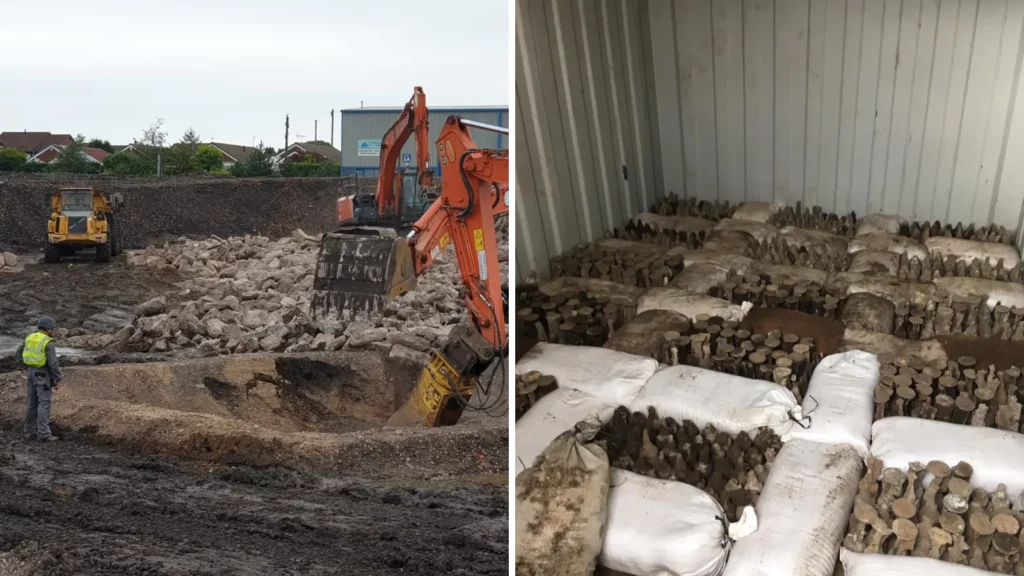
We were appointed as the principal contractor on a housing development site in Burntwood, Staffordshire, following concerns about potential UXO contamination. A Stage 2 Detailed UXO Risk Assessment, conducted at the request of the Health and Safety Executive, confirmed that the site had once hosted a military scrap yard, active during and after WWII. While the yard mainly dismantled surplus RAF aircraft, records suggested that when the Home Guard disbanded in 1944, unauthorised disposal of ammunition had also taken place.
Over 12 months, more than 3,500 individual UXO items were recovered. Working closely with the Health and Safety Executive and the local council, we developed and implemented a plan to dispose of these items safely on-site using controlled explosive demolitions.
Mappleton Beach, East Yorkshire
In 2021, we won a competitive tender from the Defence Infrastructure Organisation to manage the UXO risk at RAF Cowden, a former air weapons range near Hull. Spanning 275 hectares, this coastal site was used for artillery and air-to-ground training from the 1940s until its closure in 1998.
Erosion of the cliffs at a rate of approximately 2.5 metres per year causes previously buried ordnance to appear on the beach. Our work at Cowden has involved continued monitoring, clearance, and public safety campaigns to reduce the risk to the public who use the beach.
Make Informed Decisions with a Detailed UXO Risk Assessment
If you’re considering development on former military land, a Detailed UXO Risk Assessment is the first step towards understanding and managing UXO risks effectively.
This assessment involves in-depth research into wartime activity, construction methods, and the potential for UXO contamination on your site. Our research team considers factors such as bombing density, munition types, and post-war development to evaluate how risks may present on your site today.
The results will be provided to you in a bespoke report, outlining our findings and any recommendations for further UXO risk mitigation in a clear, structured format – providing the guidance you need to decide on the next steps.
Moving Forward, Safely
As the UK continues to address its housing needs, former military land will remain part of the picture. These sites can, and should, be developed, but only with the right precautions in place.
If you’re considering a new build project on ex-military land, get in touch with Brimstone UXO. We’ll help you uncover the site’s past, assess the present risk, and plan for a safe, successful future.
Follow Brimstone UXO on Facebook, Instagram, X, LinkedIn and YouTube for more historical insights and project updates.
If you found this blog useful, you might also like:
- The Top 15 Mistakes Housing Developers Make Regarding UXO
- What Every Developer Needs to Know About UXO Risks on Brownfield Sites
- Why Green Belt Land Could Have UXO Risks: What New Build Developers Need to Know
- How to Manage UXO Risks on Construction Sites
- The Cost of Ignoring UXO Risks
- Your Guide to CIRIA C681: Managing UXO Risks in Construction
- Why You Should Plan for UXO Risk Mitigation from the Start of a New Build Project
"*" indicates required fields