When to Bring UXO Expertise into a Geotechnical Project Timeline
Geotechnical investigations are a crucial stage in preparing a site for development. From boreholes and trial pits to in-situ testing, these works provide project teams with the essential information needed to design and build safely and effectively. Yet on many sites across the UK, an often-overlooked factor has the potential to cause disruption, delay, and serious risk to safety: unexploded ordnance (UXO).
Bringing in UXO expertise at the right point in a geotechnical project can make the difference between a smooth programme and one beset by unexpected stoppages. Early planning and proportionate risk management not only reduce the likelihood of costly delays but also ensure compliance with health and safety obligations.
Why UXO Matters in Geotechnical Projects
The risk of encountering UXO is not a distant or hypothetical concern. During the Second World War, the UK was subjected to heavy bombing campaigns, leaving a legacy of unexploded bombs, shells and other ordnance buried across the country. These items continue to be discovered on a wide range of sites: from brownfield land and former industrial areas, to greenfield plots in known bombing corridors, military ranges and redundant airfields.
For geotechnical teams carrying out intrusive ground investigation, striking or disturbing a buried bomb is a very real danger. The implications go far beyond the immediate safety of site personnel. Work can grind to a halt, emergency callouts may be required, and costs can quickly escalate. Even where incidents are avoided, a lack of appropriate UXO mitigation exposes clients and contractors to reputational and legal risks if regulators or stakeholders later question whether due diligence was carried out. By integrating UXO risk management into the project timeline, geotechnical works can progress with a far greater degree of certainty.
When to Involve UXO Specialists
There are three key points in a geotechnical project where UXO expertise is most valuable. Each stage involves different services that ensure risks are managed proportionately.
1. Preliminary UXO Risk Assessment – At the Planning Stage
The first opportunity to consider UXO is before intrusive works are scoped. A Preliminary UXO Risk Assessment is a desktop study that reviews historical military records, bombing data and site history to determine whether a credible risk exists.
This assessment is quick to obtain, usually delivered within twenty-four to forty-eight hours, and allows project teams to make informed decisions early. If no risk is identified, works can go ahead with confidence. Where a potential risk is highlighted, it can be factored into method statements, budgets and project planning from the outset, avoiding disruption further down the line.
2. Detailed UXO Risk Assessment – Before Ground Investigation
Where a preliminary study identifies a possible risk, the next step is a Detailed UXO Risk Assessment. This involves a deeper analysis of the site’s wartime history, the types of ordnance that could be present, and how proposed geotechnical works might interact with those risks.
Detailed assessments are usually completed within a few weeks and provide proportionate recommendations for managing UXO hazards. For geotechnical teams, this means having a clear, evidence-based picture before drilling, probing or trial pitting begins. It supports safe methodology choices and ensures compliance with regulations, while also providing reassurance to clients and stakeholders.
3. On-Site UXO Support – During Intrusive Works
Even with thorough risk assessments in place, some projects require direct UXO expertise on site. Having a qualified UXO engineer in attendance allows intrusive works to proceed with confidence, knowing that immediate support is available if anything suspicious is uncovered.
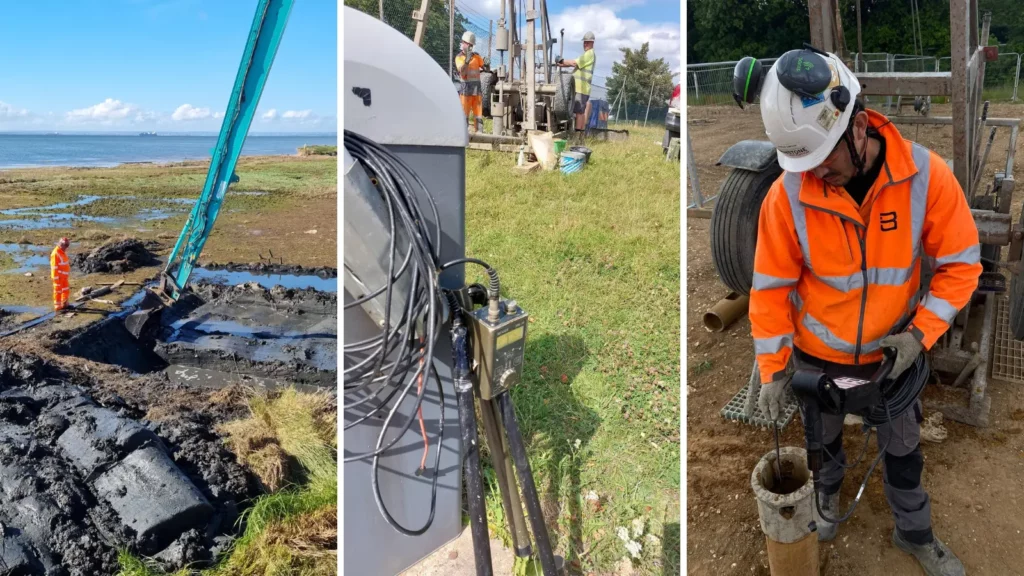
On-site involvement can take the form of a UXO watching brief during trial pitting, UXO borehole support for rotary or percussive drilling, or a more general standby presence during high-risk phases of ground investigation. At Brimstone, around half of our monthly deployments involve this kind of on-site support, highlighting how closely UXO management and geotechnical works are connected in practice.
Benefits of Early Integration
Engaging UXO expertise early brings several advantages that are difficult to achieve once groundworks are already underway. The most obvious is safety: protecting the lives of site staff and contractors must always come first.
Alongside this, there is the reassurance of programme certainty. Projects with clear UXO mitigation in place are far less likely to suffer unexpected stoppages, which means schedules remain intact. Cost savings follow naturally from this, as avoiding emergency callouts or unplanned delays is always more efficient than reacting to problems as they arise. Finally, there is the confidence it gives to clients and stakeholders. Demonstrating that UXO has been considered shows diligence, professionalism and compliance with regulations such as the CDM Regulations.
How Brimstone Can Help
Brimstone works with geotechnical teams across the UK to ensure that UXO risk is managed proportionately at every stage of a project. Our services range from rapid-turnaround preliminary assessments to in-depth risk analysis, borehole supervision and on-site support. In each case, the aim is the same: to allow geotechnical works to proceed safely, smoothly and without unnecessary disruption.
If you are planning geotechnical investigations and would like advice on when to bring UXO expertise into your programme, our team is available to support you. To learn more about how we help geotechnical projects, follow Brimstone on Facebook, Instagram, LinkedIn and YouTube.
"*" indicates required fields