Why Green Belt Land Could Have UXO Risks: What New Build Developers Need to Know
The UK government’s drive to build 1.5 million new homes over the next five years will bring significant changes to land use, including the release of green belt and so-called ‘grey belt’ land. With councils now required to review and potentially release lower-quality green belt land to meet their housing targets, developers will increasingly find themselves building on previously protected sites. However, what many may not consider is the potential for unexploded ordnance (UXO) risks on these parcels of land.
Failing to assess UXO risks early can result in costly delays, unexpected expenses, and serious safety hazards. In this blog, we’ll explore why green belt and grey belt land can hold UXO risks and why early UXO risk mitigation is essential for keeping new build projects safe and on schedule.
What is Green Belt and Grey Belt land?
Green belt land is protected countryside surrounding urban areas, designed to prevent urban sprawl and preserve green spaces. It was established over 70 years ago and is reported to cover approximately 13% of England. However, to meet ambitious housing targets, councils are now tasked with identifying and releasing lower-quality green belt land where necessary.
Grey belt land refers to green belt areas with previous development or degraded land quality, such as:
- Land on the edge of existing settlements or transport routes.
- Old petrol stations, car parks, and derelict industrial sites.
- Areas with limited ecological or agricultural value.
While much of this land appears rural or semi-rural today, its history may include wartime activity, military training, or former industrial use, all of which can leave behind UXO contamination.

Why Green Belt and Grey Belt land can contain UXO
Wartime bombing and defensive positions
During WWII, extensive bombing campaigns targeted urban areas, with many bombs falling on the outskirts of towns and cities – today’s green belt land. In some cases, high explosive bombs missed their targets and landed in nearby rural areas. Additionally, defensive positions such as anti-aircraft batteries, decoy sites, and munitions storage depots were often located on what is now considered green belt or grey belt land.
Former military and industrial sites
Some of the grey belt land earmarked for potential development includes sites with a military or industrial history. These sites may have been used for:
- Munitions production or storage, leaving behind UXO.
- RAF or Army training grounds, where practice firing could have resulted in UXO contamination.
- Disused airfields or defence infrastructure, with associated UXO risks.
Unrecorded UXO and post-war clearance limitations
While many bombed areas were cleared after the war, UXO was not always thoroughly removed, particularly in rural or undeveloped areas. Clearance efforts were often focused on built-up zones, meaning countryside and green belt areas were sometimes overlooked.
Many munitions were also deliberately abandoned after the war. During and after WWII, the Home Guard and other military personnel often disposed of unused ordnance by burying it in remote areas. This practice was common on rural farmland and woodland, much of which has since become part of the green belt or brownfield land.
The result is that unrecorded UXO still exists, and even decades later, construction projects continue to uncover UXO that was never officially recorded or cleared.
Real-life examples: UXO found on Green Belt and Grey Belt land
Cleve Hill Solar Park – Faversham
In 2021, Brimstone undertook a UXO drone survey on 316 hectares of farmland for a new solar park project in Faversham, resulting in multiple UXO finds at a depth of 1 metre.
Routine power network upgrade – Dumfries and Galloway
In 2019 engineers working on a routine power network upgrade stumbled across a stash of 70 unexploded Home Guard phosphorus grenades, also known as SIP grenades, near Tongland Dam in Dumfries and Galloway.
New build housing development – Stratford upon Avon
In October 2022, a construction worker working on a new build development was badly burned after his digger unknowingly struck a crate of Home Guard SIP grenades.
Army cadet training facility extension – Beckingham
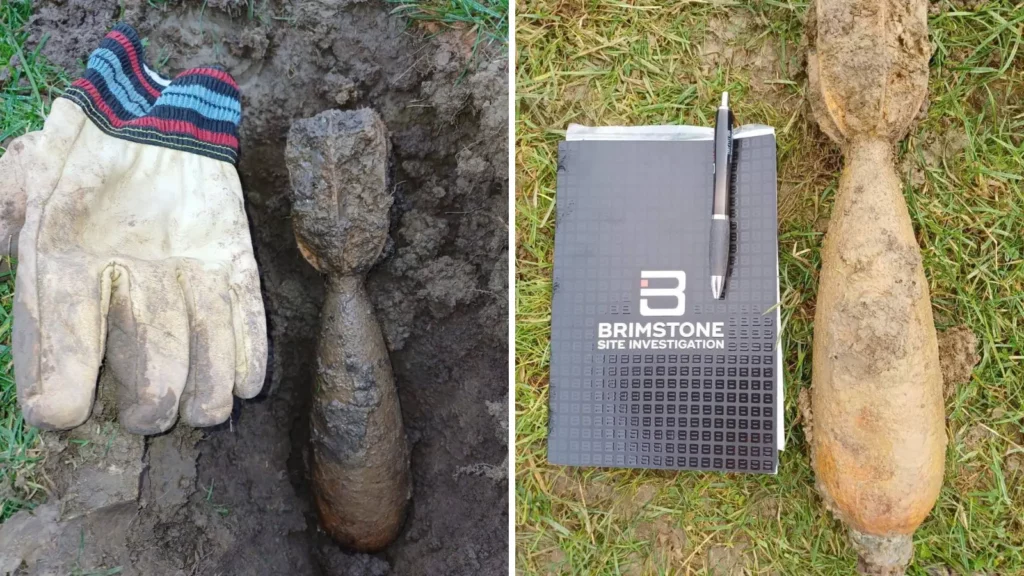
Brimstone deployed a team to Beckingham to conduct a UXO survey on 2 hectares of grey belt land prior to the extension of an Army cadet training facility. When analysing the data post-survey, our technical team discovered several anomalies that matched the characteristics of UXO. We deployed our team back to the site in early 2024 to conduct a target investigation, which resulted in a 3” ML Mortar being discovered.
The importance of UXO risk assessments for Green Belt developments
With new build housing developments expanding into green belt and grey belt land, UXO risk mitigation is more important than ever. Developers cannot afford to overlook unexploded ordnance risks. UXO risk assessments are crucial to:
- Identify potential UXO risks before construction begins.
- Prevent costly delays caused by unexpected UXO finds.
- Ensure site safety and compliance with health and safety regulations.
- Avoid reputational damage and financial losses.
At Brimstone UXO we offer two types of UXO Risk Assessment which evaluate the likelihood of UXO contamination on a site ahead of any works starting. Our reports provide new build developers with clear, actionable recommendations based on historical research, mapping, and expert analysis.
- Preliminary UXO Risk Assessments – With a 24 to 48-hour turnaround, this assessment is the most cost-effective and fastest way of determining or discounting UXO risks for your site. The purpose of a preliminary assessment is to determine whether further research is required or not, and why.
- Detailed UXO Risk Assessments – If your site is a former military site or a preliminary assessment identifies potential UXO risks, you’ll need a detailed UXO risk assessment. This involves in-depth research into enemy action or military activity on or near a site, and explores how modern construction methods and other human factors affect the likelihood of encountering UXO.
If the risk assessment results in a moderate or high risk for UXO, we will recommend further UXO risk mitigation is carried out. This might be in the form of:
- Non-Intrusive UXO Surveys – uses a pushed, towed, or drone format to identify shallow-buried UXO without having to disturb the ground.
- Intrusive UXO Surveys – involves physically penetrating the ground to detect deep buried ferrous objects that could be unexploded ordnance.
- Watching Brief – involves the continuous monitoring of ground intrusion activities by a qualified UXO engineer to identify the presence of UXO or items relating to military activity.
- Borehole Support – using a down-hole probe to clear borehole positions as they get progressively deeper.
Our team will work with you to understand which UXO risk mitigation service is most suitable for your project, timescales and proposed works.
How Brimstone UXO supports new build developers
With the government’s push for green belt and grey belt development, UXO risks must be a key consideration in project planning and risk management. Don’t let unexploded ordnance derail your build – contact Brimstone for expert UXO support.
Stay connected with Brimstone by following us on Facebook, Instagram, X, LinkedIn and YouTube.
If you found this blog useful, you might also like:
- The Cost of Ignoring UXO Risks
- How to Manage UXO Risks on Construction Sites
- What Every Developer Needs to Know About UXO Risks on Brownfield Sites
- Why You Should Plan for UXO Risk Mitigation from the Start of a New Build Project
- The UXO Risks of Former Military Land Being Repurposed for Housing
- The Top 15 Mistakes Housing Developers Make Regarding UXO
"*" indicates required fields