
UXO Desk Study_
Desk-based UXO research that tells you whether your site carries a credible risk, before a single spade goes in the ground.
A UXO desk study, also known as a desk-based UXO risk assessment, examines your site’s military history to establish whether unexploded ordnance could be present. Brimstone desk studies are researched and written in-house from primary archive sources, comply with CIRIA C681 and C785, and can be delivered in as little as 24 to 48 hours.
What is a UXO desk study?
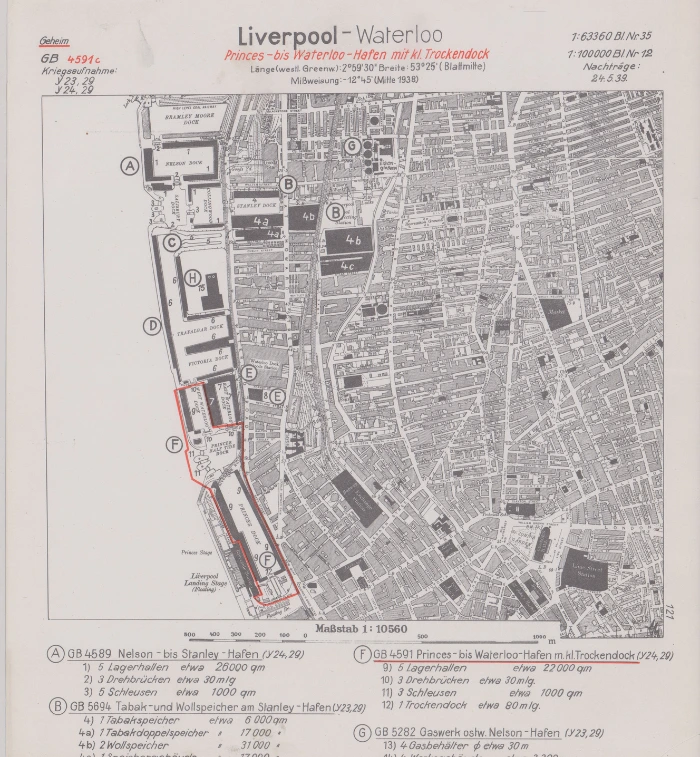
A UXO desk study is a research-based investigation into the likelihood of unexploded ordnance affecting a site. No fieldwork is involved at this stage. Instead, experienced researchers analyse historical records covering wartime bombing, military land use, munitions manufacturing and storage, and post-war development, then assess what that history means for your planned groundworks.
You may also see this work described as a desktop study, a desk-based assessment, or a UXO risk assessment. These terms describe the same thing.
Under the industry frameworks CIRIA C681 and C785, desk studies are delivered in two stages: a Stage 1 Preliminary Risk Assessment, which quickly establishes whether a credible risk exists, and a Stage 2 Detailed Risk Assessment, which is commissioned where Stage 1 identifies risk or where a site has a known military history.
Most UK sites are resolved at Stage 1 with a low risk rating, making a desk study the fastest and most cost-effective way to discharge your duty of care and keep your project moving.

What’s included in a UXO desk study?
Every Brimstone desk study is built from primary and secondary sources, interpreted by in-house researchers, and supported by the largest proprietary historical UXO dataset held by any UK consultancy. We do not use automated report generation.
Your report covers:
- Wartime bombing records and bombing density relevant to your site
- Military land use, including training, manufacturing, and munitions storage
- Post-war development history
- A clear risk rating with defensible reasoning
- Practical, proportionate recommendations your planner, principal designer, or contractor can act on

When do you need a UXO desk study?
A desk study should be commissioned as early as possible, ideally at the planning or pre-construction stage. Common triggers include:
- Intrusive works on a site with no previous UXO assessment, including piling, deep foundations, service trenches, and ground investigation boreholes
- A planning condition or principal designer requirement to assess UXO risk
- CDM Regulations duty of care, which requires foreseeable risks, including UXO, to be assessed and managed
- Lender, insurer, or client due diligence ahead of a land transaction or major programme
Previous safe development is not evidence of a clear site. UXO can lie undisturbed for decades, and deeper or more intrusive works are a common trigger for first-time discoveries on familiar ground.

What happens after a desk study?
If your desk study returns a low risk rating, no further UXO work is needed and the report stands as your documented evidence of due diligence.
If a credible risk is identified, the report sets out the proportionate next step rather than defaulting to expensive mitigation. Depending on the risk and your planned works, that might be a non-intrusive or intrusive UXO survey, on-site supervision during groundworks, or risk zoning to focus mitigation only where it’s needed.
As Brimstone delivers every stage of UXO risk management in-house, the route from desk study to mitigation is seamless.
Where a Stage 2 Detailed Risk Assessment is needed, Brimstone can deliver it to the semi-quantitative standard originally set out in CIRIA C681 – a defensible number, not just a colour rating – where insurance, commercial, or engineering decisions demand it.
Projects Involving Desk Studies_
Frequently Asked Questions_
There is no practical difference. A UXO desk study is a desk-based UXO risk assessment; the two terms are used interchangeably across the industry. Under CIRIA C681 and C785 the work is delivered as a Stage 1 Preliminary Risk Assessment and, where needed, a Stage 2 Detailed Risk Assessment.
There is no specific legal requirement, but developers and employers have a duty of care under health and safety legislation, including the CDM Regulations, to assess foreseeable risks. A desk study is the recognised first step in demonstrating that UXO risk has been properly considered, and it is increasingly requested through planning conditions and ground investigation specifications.
No. A desk study is research-based and involves no site work. A UXO survey is a physical, on-site investigation using equipment to detect buried ferrous objects, and is only recommended where a desk study has identified a credible risk.
If your works involve ground disturbance and the site hasn’t been assessed before, a UXO desk study is the right starting point. It reviews historical records, aerial photography, and other sources to establish whether there’s a credible risk of UXO at your location, even in areas with no recorded bombing, due to military training, manufacturing, or munitions storage activity.
Get a quote for your UXO Desk Study
Tell us about your site and we will come back with a fixed quote within one working day. Prefer to talk? Call 0207 117 2492 or email enquire@brimstoneuxo.com.
"*" indicates required fields