UXO Risks Beneath Existing Buildings | What Developers Should Consider
When it comes to unexploded ordnance (UXO), one question we are often asked is: Could there be UXO beneath an existing building?
The short answer is yes.
While UXO risk is often associated with open or undisturbed land, history and past construction practices show that even developed sites can present a risk.
Buildings may have been constructed over unknown UXO
Many structures in the UK were built before UXO risk mitigation became a standard part of development planning. In other cases, measures may have been in place but not carried out correctly, or the level of understanding of UXO risk at the time was limited. This means a building could have been constructed over buried ordnance without anyone being aware of it – or even knowing to check!
There is also the possibility that earlier assessments failed to identify the risk. During WWII, a generally accepted failure rate of around 10 percent is associated with German high-explosive bombs, based on records gathered by bomb disposal units. These statistics do not account for unexploded bombs that went entirely unnoticed.
Importantly, this does not only relate to German ordnance. It also does not account for Allied UXO, which may be present as a result of defensive activities, manufacturing, storage, testing and training across the UK.
Bomb failures occurred for several reasons, including:
- Equipment or human error in arming bombs before release
- Failure of a mechanism within the fuze
- Jettisoning of payloads if an aircraft was under attack or in distress
- Partially functioning bombs, for example due to defects in explosive fillings
Due to the scale of bombing and limited resources, bomb disposal units were often overstretched. Devices were triaged based on location and perceived risk. Some unexploded bombs were intentionally left in situ and recorded on what became known as the Abandoned Bomb Register. This register is now held in the Parliamentary Archives, but it should not be relied upon as a complete or fully accurate record.
Another key historical dataset is the Bomb Census, compiled by the Ministry of Home Security using reports from ARP wardens. Its purpose was to support intelligence gathering and assess bombing density. However, early wartime records were less reliable, and the quality of information varied across the country. Some records are held at The National Archives, while others are stored in local archives.
Together, this means that historical records are invaluable, but not perfect. Understanding a site’s history is essential, but uncertainty can remain.
The ‘J-curve effect’ and horizontal offsets
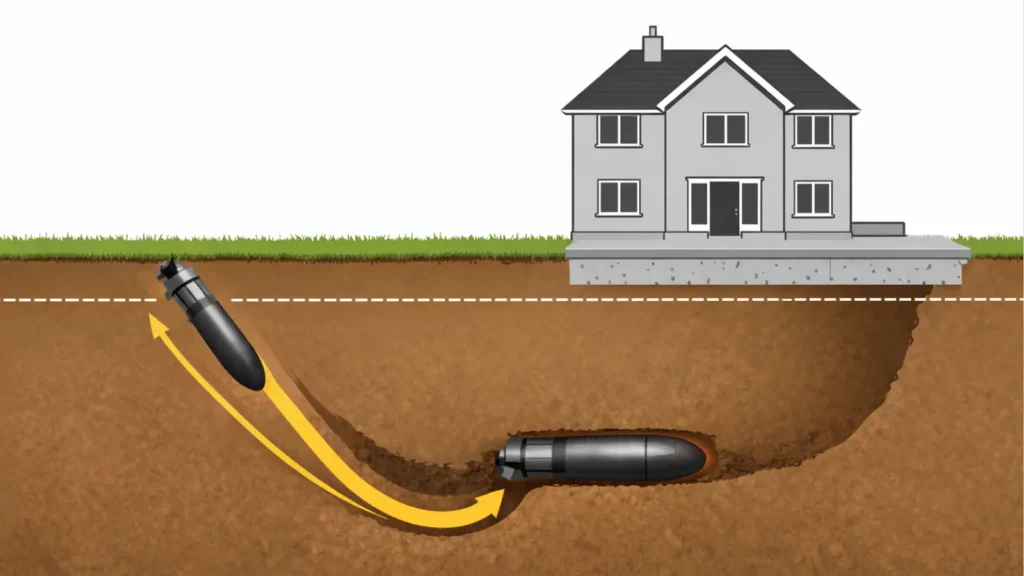
A crucial concept for developers to understand is the ‘J-curve effect’. WWII bomb disposal units observed that many buried unexploded bombs were found horizontal or even upturned, rather than vertical.
When a high-explosive bomb penetrates the ground at an angle, slightly off vertical, its underground path curves, forming a J-shape. This creates a horizontal offset between the point of entry and the bomb’s final resting position.
This offset is typically estimated at around one third of the bomb’s penetration depth. In cases involving low-angle impacts, such as low-altitude attacks, the offset can be significantly greater, sometimes up to 15 metres!
For developers, this means the final location of a buried bomb may not correspond with mapped impact points. A device that entered the ground outside a building footprint could come to rest beneath it.
Recommended approach for developers
The most effective way to address potential UXO risks beneath existing buildings is to begin with a UXO risk assessment.
Our Preliminary UXO Risk Assessments typically have a turnaround of 48 hours and are a fast, cost-effective way to identify or discount potential risk to support safe project planning. If a potential risk is identified, a Detailed UXO Risk Assessment will be recommended.
A Detailed UXO Risk Assessment involves comprehensive research into historical military activity and enemy action in the area, alongside analysis of how modern construction methods and human activity may influence the likelihood of encountering UXO. It also considers the types of ordnance that could be present and the maximum depths at which they may be found.
For sites where there is concern about UXO beneath an existing building, our research team will examine factors such as:
- Recorded bombing density and strike patterns
- Proximity to known targets or military infrastructure
- What buildings existed pre- and post-war, and their condition
- Geological and ground conditions affecting penetration depth
- Historical land use and previous ground disturbance
For buildings planned for demolition or redevelopment, any further risk mitigation recommendations are typically focused on the ground phase of works rather than the demolition itself. Once ground-intrusive works begin, measures may include:
- Post-demolition intrusive UXO surveys
- UXO watching briefs during excavations
- UXO safety awareness briefings for site teams
Early engagement with a specialist UXO company helps ensure risks are managed proportionately, supporting both safety and programme certainty.
Protect your development and your team
UXO risk is not limited to undeveloped land or new build sites. Existing buildings, particularly in historically affected areas, can still sit above buried unexploded ordnance.
By understanding the historical context of a site, the implications of the J-curve effect, and by following a structured assessment and mitigation process, developers can manage UXO risk responsibly and safely.
Contact us today to discuss UXO risks on your site.
For regular updates, insights, and industry guidance, follow Brimstone on Facebook, Instagram, LinkedIn and YouTube.
"*" indicates required fields