The Coventry Blitz: History, Impact and UXO Risks
During World War II, Coventry was a major hub for Britain’s engineering and armament production. Aircraft, engines and munitions rolled out of its factories, while the city itself carried centuries of cultural and historical significance. These qualities made Coventry a prime target for the Luftwaffe (German Air Force).
In November 1940, Coventry endured one of the most infamous raids of the war. Known as the “Coventry Blitz”, vital infrastructure, landmarks, and residential areas suffered irreparable damage and destruction.
Today, Coventry stands as a symbol of resilience. Yet the legacy of wartime bombing continues to pose hidden risks, particularly in the form of unexploded ordnance (UXO).
Coventry’s Strategic Importance
In the decades leading up to WWII, Coventry had transformed into a hub of modern industry. Its strong motor trade infrastructure made it a natural choice for rapid conversion to wartime production. With the threat of war imminent, the government implemented its “Shadow Factory” scheme, commissioning companies such as Dunlop, Rolls Royce and Whitworth to produce vital aircraft engines and munitions.
While essential to the war effort, this concentration of manufacturing marked Coventry as a target. Defences were deployed, including anti-aircraft guns, barrage balloons and signal jammers. Despite these measures, Coventry’s position and industrial density made it highly vulnerable.
The Coventry Blitz
On the night of 14th November 1940, codenamed Operation Moonlight Sonata, the Luftwaffe launched one of the most concentrated bombing raids of the war. While the aim was to destroy major centres for war production, it was also said to be an act of revenge ordered by Hitler for an RAF attack on Munich.
The raid was one of the first to use Pathfinders, a squadron of 13 planes known as Kampfgruppe 100. Flying ahead of the main fleet, the Pathfinders dropped incendiary explosives to start fires that would act as markers, guiding the following bombers directly to the city.
Over 500 bombers flew repeated sorties for more than 11 hours, dropping thousands of incendiaries and high explosives over Coventry. Initial waves illuminated targets with incendiaries, which combined with a bright moon, allowed later bombers to navigate by sight alone. British defences were quickly overwhelmed. 121 British fighter sorties were launched, but only a handful of enemy aircraft were intercepted.
The scale of destruction was so great that the German word “coventrieren” came to mean “to devastate by heavy bombing.”
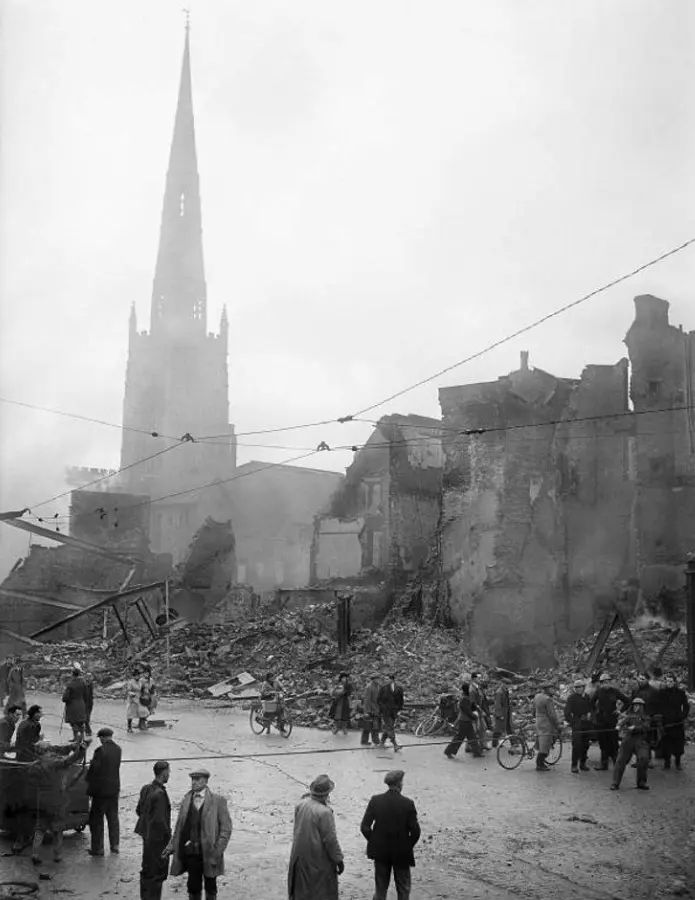
The Coventry blitz killed an estimated 507 civilians and seriously injured hundreds more. Around 43,000 of the city’s homes were destroyed or damaged. Factories, workshops and key infrastructure were left in ruins. The medieval St Michael’s Cathedral, despite attempts at protection by a dedicated fire watch, was gutted by fire and reduced to rubble after being hit multiple times. Civilians taking shelter were evacuated from the crypts below and any valuables within were removed for their protection.
It was reported that the fire at the Daimler works was one of the biggest of the war in Britain. Up to 150 high explosive bombs and 3,000 incendiaries turned 15 acres of factory buildings into a raging inferno. Other major buildings destroyed included the Market Hall, Central Library, Coventry and Warwickshire Hospital, and hundreds of shops and public buildings.
While the November 1940 raid became infamous, it was not the only time Coventry came under heavy attack. The city endured a series of smaller raids both before and after that night. On 25th August 1940, a considerably heavy raid caused extensive damage, including the destruction of the newly built Rex ‘Super Cinema’. Fortunately, no fatalities occurred, although several people required hospital treatment. Further bombing followed in April 1941, when two major raids again struck the city, compounding the devastation already suffered.
Aftermath and Rebuilding
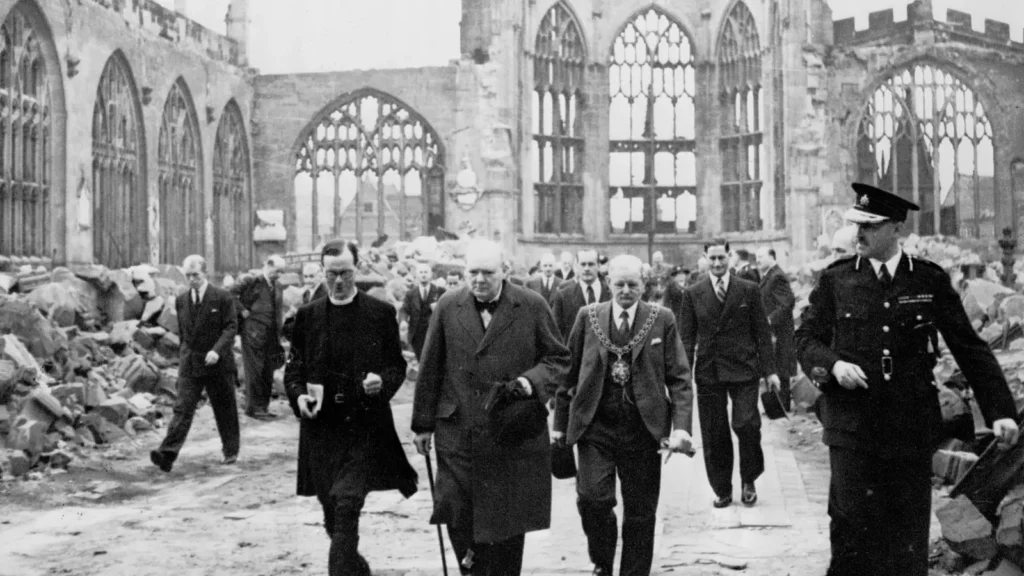
In the days that followed the Coventry blitz, fire crews extinguished blazes that had burned for hours. King George VI visited the city on 16th November, walking among the ruins of the Cathedral. Jock Forbes, St Michael’s stonemason, who had been part of the fire watch team that night, put two of the charred beams together to make a cross that was placed near the ruined altar.
Beyond the physical destruction, the raid had a profound social impact on the people of Coventry. In the aftermath of the bombing, more than half of the city’s population fled into the countryside to stay with friends or relatives, or in some cases to sleep in fields. The authorities estimated there were 2,500 homeless people. The overwhelmingly dominant feeling was utter helplessness. Such was the intensity of the raid that two-thirds of the buildings in the centre of Coventry were destroyed, leaving many practically speechless. This was exactly the reaction the government had feared.
Compared with larger cities like London, Birmingham, and Liverpool, where raids were spread over a wider area, the effects on Coventry were far more concentrated and devastating. The raid was seen as particularly indiscriminate and inhumane, and although London had already suffered more bombs and casualties, the scale of destruction in Coventry’s relatively small city centre brought the attack to the attention of the world. Unusually, the Ministry of Information chose not to keep the results quiet, but instead used the press to publicise the devastation. The destruction of so many homes, and especially the Cathedral, drew widespread condemnation of Nazi Germany.
Yet, within weeks of the raid, and contrary to expectation, the city revived. Despite deprivation, factories were soon turning out aircraft parts at record pace. Production soared, and Coventry became a symbol of determination and resilience in the face of suffering.
It was decided that the ruins of St Michael’s Cathedral would be preserved, in memorial to the devastation caused. A new St Michael’s Cathedral was consecrated in 1962, standing alongside the preserved ruins of the old.
Today, Coventry remains an industrial and cultural hub, with major contributions in automotive, aerospace and education. Its designation as UK City of Culture 2021 further highlights its ability to adapt and thrive.
Memorials across the city, from Bayley Lane to the Blitz Museum within the Cathedral itself commemorate the lives lost and the destruction endured.
Unexploded Ordnance: A Lingering Danger
The scale of bombing in Coventry means that not every device detonated as intended. Historical records suggest up to 10% of bombs failed to explode on impact, leaving a hidden legacy beneath the city.
These risks have not faded with time. A notable example came in September 2015, when a 1-tonne unexploded bomb was discovered on a building site in Coventry. The device was made safe by MOD specialists through a controlled explosion.
Such discoveries underline the importance of factoring UXO risks into redevelopment projects, particularly across former industrial and residential areas that were heavily bombed.
UXO Support for Coventry Construction and Development Projects
The Coventry Blitz was one of the darkest nights in Britain’s wartime history. Yet as Coventry continues to grow and regenerate, the legacy of WWII remains just below the surface.
At Brimstone UXO, we specialise in identifying and mitigating UXO risks, keeping construction projects safe and on schedule. Our services include:
- UXO Risk Assessments – researching your sites military history and assessing the likelihood of UXO contamination.
- UXO Surveys – both intrusive and non-intrusive surveys to detect potential buried ordnance.
- On-Site Support – from borehole supervision to search and clear operations, ensuring safe groundworks and excavation.
If you’re planning a development in Coventry or the wider Midlands, our commercial team can support you in managing these hidden risks.
Get in touch with Brimstone UXO
The story of Coventry is one of endurance and renewal. From the ruins of the Blitz, the city rebuilt itself into a modern centre of industry, culture and education, but the dangers left behind by wartime bombing remain real and must be addressed.
By understanding and mitigating UXO risks, we can ensure that Coventry continues to thrive safely for generations to come.
Get in touch with Brimstone UXO to learn more about our services and how we can support your next project. You can also follow us on Facebook, Instagram, X, LinkedIn and YouTube.
"*" indicates required fields